 admin@graminguru.in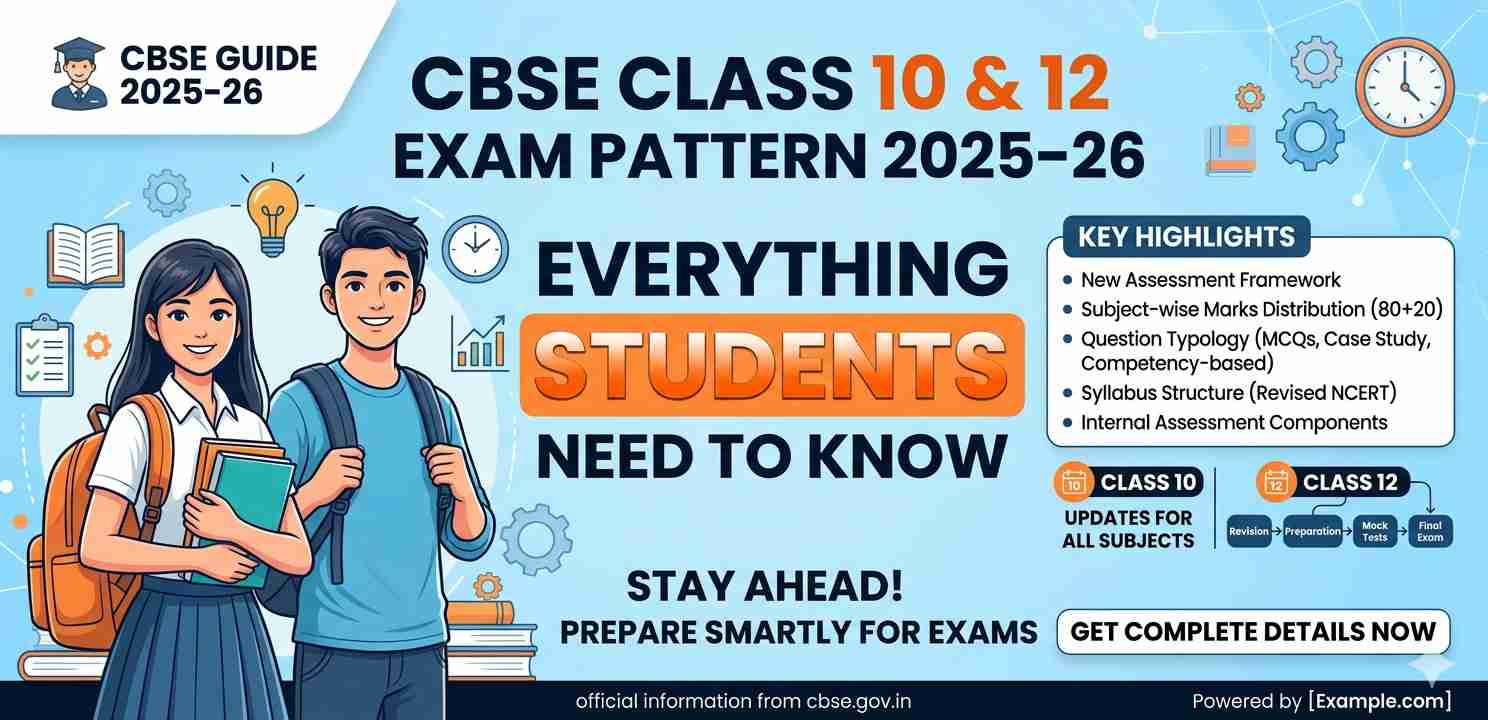
Introduction
Every year, millions of students across India sit for their CBSE board exams. And every year, a big chunk of them feel underprepared — not because they didn’t study, but because they didn’t fully understand how the exam actually works.
The CBSE Exam Pattern 2025–26 has seen some important updates. If you’re in Class 10 or Class 12 right now, understanding this pattern is honestly one of the most useful things you can do before you open a single textbook.
This article breaks it all down — clearly, honestly, without any confusion.
What Is the CBSE Exam Pattern and Why Does It Matter?
The exam pattern tells you how a paper is structured — how many questions there are, what types they are, how marks are distributed, and what the time limit looks like.
Knowing the CBSE Exam Pattern 2025–26 helps you plan your study schedule better. You stop wasting time on sections that carry fewer marks, and you focus more on areas that matter.
A lot of students jump straight into reading chapters without knowing this. That’s like trying to win a cricket match without checking how many overs are left.
CBSE Exam Pattern 2025–26 for Class 10
Overview of the Class 10 Board Structure
Class 10 students appear for the annual board exams conducted by CBSE. The CBSE Exam Pattern 2025–26 for Class 10 follows a theory plus internal assessment model.
For most subjects, the total marks are divided as:
- 80 marks — Theory (board exam)
- 20 marks — Internal assessment (school level)
Some subjects like Mathematics, Science, and Social Science carry 80 marks in the theory paper. Languages like Hindi and English also follow this split.
Types of Questions in Class 10 Papers
The CBSE Exam Pattern 2025–26 includes a mix of question formats:
- Objective type questions (MCQs, Assertion-Reason)
- Very Short Answer (VSA)
- Short Answer (SA)
- Long Answer (LA)
- Case-based questions (very important now)
Case-based questions were introduced a few years ago and have stayed. They test whether a student can apply what they’ve learned to a real-life scenario. In Science, for example, you might get a short paragraph about an experiment, followed by 4–5 questions based on it.
Internal Assessment in Class 10
The 20 internal marks are usually split between:
- Periodic tests (10 marks)
- Notebooks and subject enrichment (5+5 marks)
Your school handles these. They vary a bit from school to school, but CBSE sets the general guidelines.
CBSE Exam Pattern 2025–26 for Class 12
Overview of the Class 12 Board Structure
Class 12 is a high-stakes year. The CBSE Exam Pattern 2025–26 for Class 12 follows a similar theory plus practical/internal model, but the weightage shifts depending on the subject.
For most core subjects:
- 70 marks — Theory (board paper)
- 30 marks — Practical or internal assessment
In subjects like Physics, Chemistry, and Biology, the 30 marks come from practicals conducted at school. For Accountancy, Business Studies, and Economics, it’s more internal assessment-based.
Question Types in Class 12 Papers
The CBSE Exam Pattern 2025–26 for Class 12 also uses multi-level question types:
- MCQs and Objective Questions (1 mark each)
- Short Answer Type I (2 marks)
- Short Answer Type II (3 marks)
- Long Answer Type I (4–5 marks)
- Long Answer Type II (6 marks)
Competency-based questions now form a significant portion of Class 12 papers too. These test your reasoning ability, not just memory.
Practical Exams in Class 12
Practicals in Science subjects are usually conducted in January–February, before the theory exams. These are school-based but evaluated externally. Students often overlook practicals until the last minute — which is a mistake, because 30 marks is a big deal.
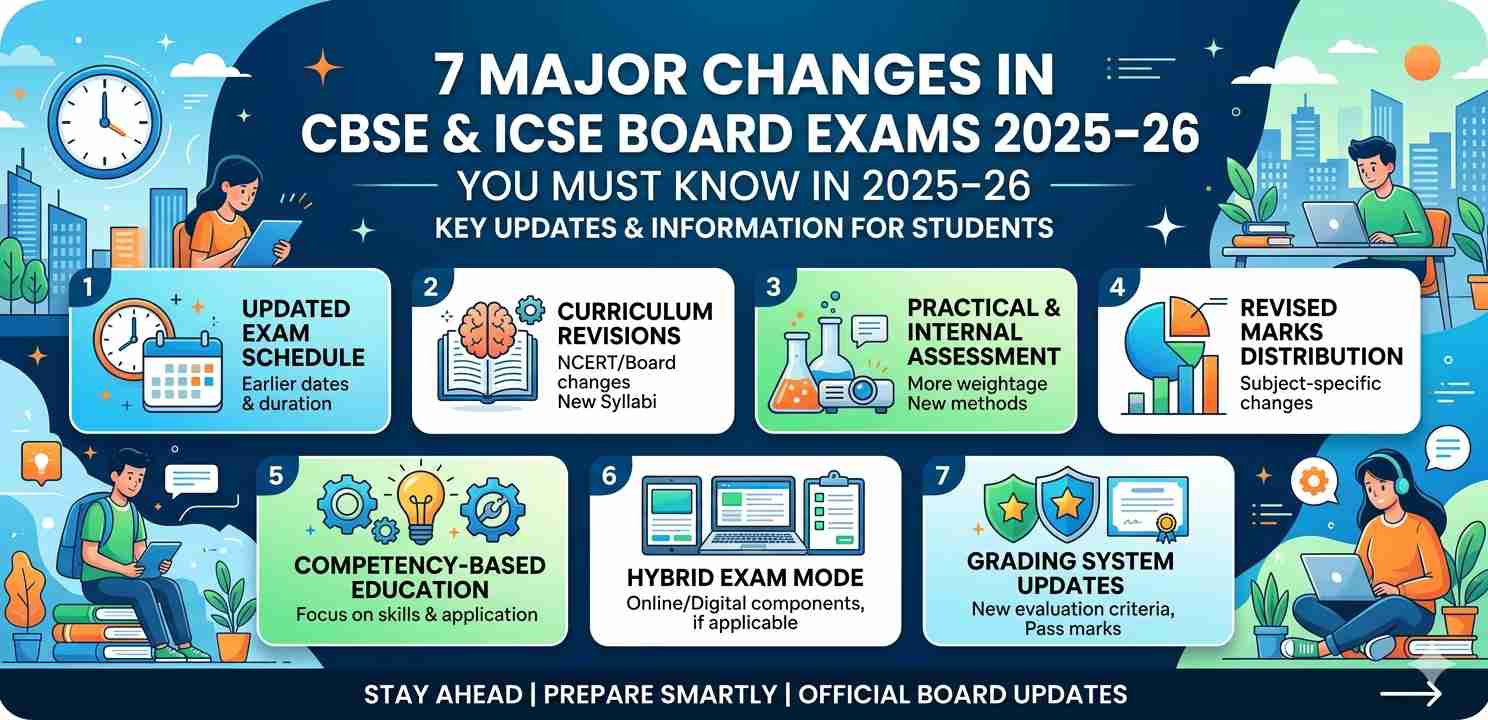
Key Changes in the CBSE Exam Pattern 2025–26
CBSE has been gradually shifting away from rote memorization. Here’s what’s different or emphasized in the CBSE Exam Pattern 2025–26:
Higher weightage to competency-based questions — CBSE aims to have around 50% of marks from competency-based questions across Class 10 and 12. This includes MCQs, case studies, and source-based questions.
Reduced descriptive questions — Long 6-mark questions are fewer compared to older patterns. The focus has shifted to shorter, more applied answers.
No choice in MCQs — In the objective section, there are no internal choices. Students must attempt all objective questions.
Internal choices in descriptive sections — Long answer questions usually offer one internal choice (either/or format).
How to Use the CBSE Exam Pattern 2025–26 for Your Preparation
Understanding the pattern is step one. Using it smartly is step two.
Focus on Competency-Based Questions First
Since these carry the most marks now, practice case-based questions regularly. CBSE’s official sample papers (available on their website at cbse.gov.in) are the best place to start. You can also check NCERT’s official portal for curriculum-aligned resources.
Solve Previous Year Papers
Nothing teaches you the exam pattern better than actual past papers. Once you know how the CBSE Exam Pattern 2025–26 is structured, doing past papers will start to feel much more useful.
Aim to do at least 5–6 full-length papers per subject before the exam. Time yourself properly — don’t just casually flip through.
Don’t Ignore Internal Assessment
Students often treat internal marks as guaranteed. They’re not. Be consistent with periodic tests and maintain your practical files properly. These 20–30 marks can pull your final percentage up significantly.
Subject-Wise Quick Reference
Mathematics (Class 10 & 12)
- Heavy on MCQs and short answers
- Case-based questions have increased
- No calculators allowed
Science (Class 10)
- Separate sections for Physics, Chemistry, Biology within one paper
- Diagram-based questions are common
- Practicals carry 20 marks internally
English (Class 10 & 12)
- Reading, Writing, Grammar sections
- Long writing tasks (articles, letters, speeches)
- Literature section tests comprehension, not just recall
Accountancy & Business Studies (Class 12)
- Case studies are now a major part
- Application-based questions over definition-based ones
- Internal assessment matters here
Common Mistakes Students Make When Ignoring the Exam Pattern
A lot of students study hard but still underperform. Here’s why:
They spend equal time on all chapters without checking the marks distribution. They skip case-based practice because it feels unfamiliar. They write very long answers for 2-mark questions, wasting time. They don’t read the instructions on the question paper carefully.
Knowing the CBSE Exam Pattern 2025–26 in advance removes most of these mistakes before they even happen.
Where to Download the Official Sample Papers
CBSE releases official sample papers for all subjects every year. For 2025–26, you can find them on the official CBSE website. These papers reflect the actual exam format accurately and include a marking scheme.
You should treat these sample papers as mandatory — not optional. They show you exactly how the CBSE Exam Pattern 2025–26 looks in practice.
Also check your school’s academic section — many schools share CBSE circulars and updated blueprints.
Final Conclusion
The CBSE Exam Pattern 2025–26 isn’t just a formality to glance at and forget. It’s a roadmap. It tells you where the marks are, how the questions are framed, and where to put your energy.
Whether you’re in Class 10 preparing for your first major board exam, or in Class 12 with your future stream on the line — take the time to sit with the pattern. Understand it. Then build your study plan around it.
Students who do this tend to feel calmer on exam day. And calmer students almost always perform better.
Start with the sample papers. Practice competency-based questions. Don’t let the internals slip. That’s it — nothing complicated.