 admin@graminguru.in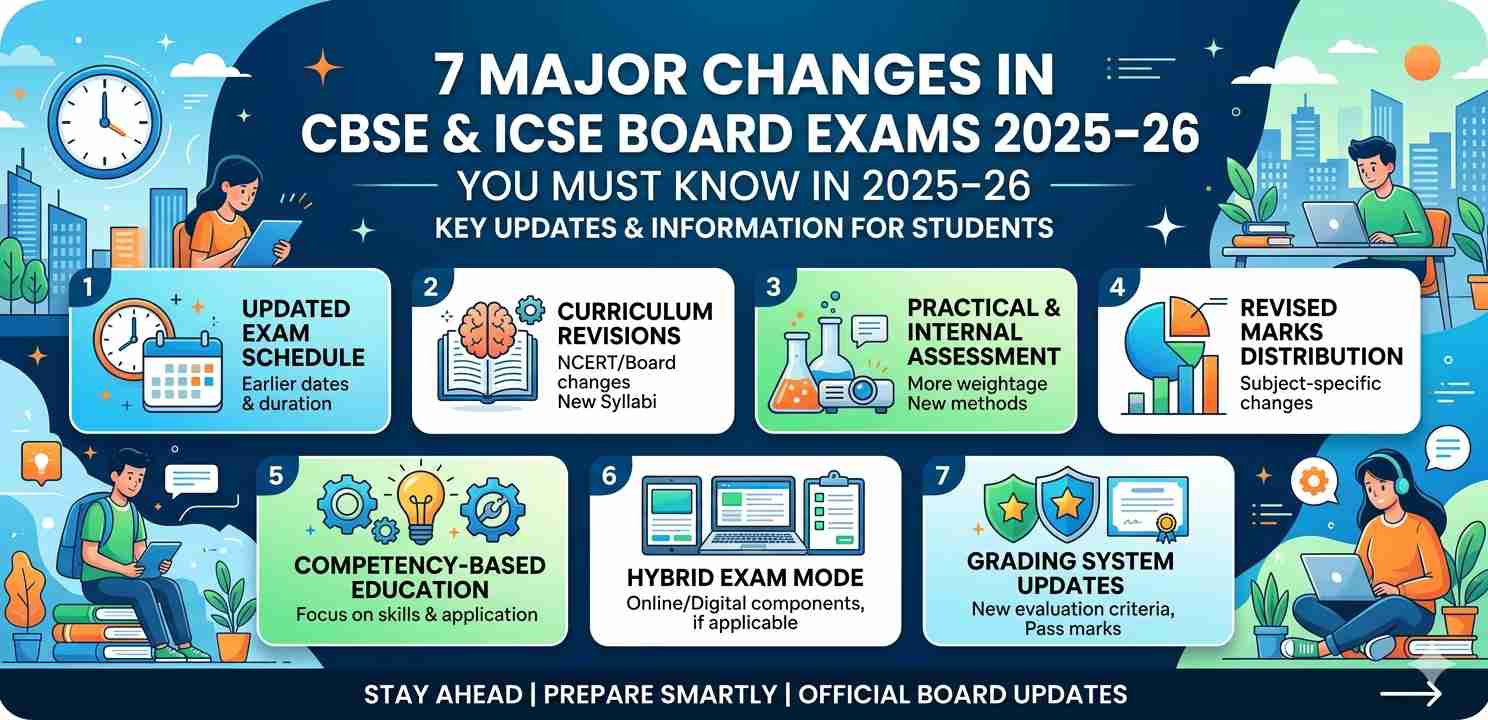
Introduction
Every year, millions of students across India prepare for their CBSE and ICSE Board Exams with full dedication. But 2025–26 is a little different. Both boards have rolled out some significant updates — changes in exam patterns, marking schemes, internal assessments, and even how results are processed.
If you’re a Class 10 or Class 12 student, or a parent trying to guide your child, staying updated on these changes is not optional anymore. Missing even one key update can affect how you prepare and how you perform. This article breaks down all 7 major changes in CBSE and ICSE Board Exams in simple, easy-to-understand language — no jargon, no confusion.
Let’s start from the basics and work our way through every change that matters for 2025–26.
1. Revised Exam Pattern and Question Paper Design
One of the biggest shifts in CBSE and ICSE Board Exams this year is in the structure of question papers. CBSE has increased the weightage of competency-based questions — that means more application-level and analytical questions instead of straight memorisation ones.
For Class 10 and 12 both, around 40–50% of the paper now includes multiple-choice questions, case studies, and source-based questions. Students who used to rely on rote learning will find this challenging if they haven’t adapted their study approach yet.
ICSE has also revised its paper pattern. The Council for the Indian School Certificate Examinations (CISCE) now emphasises concept clarity over textbook reproduction. Long-form essay-style answers are being replaced gradually with structured short answers.
What this means for you: Practice past papers with the new format. Don’t just revise — understand the concept behind each topic.
2. Internal Assessment Marks Have More Weight Now
In previous years, internal assessments in CBSE and ICSE Board Exams were sometimes treated as an easy 20 marks. That’s no longer the case.
CBSE has made internal assessment more structured and mandatory. Practical work, projects, and periodic tests are now recorded and submitted online through school portals. Teachers can’t just give marks casually — there’s a monitoring system in place.
ICSE has a similar approach. The board has reinforced that internal practical marks must be backed by actual lab records, project files, and regular classwork. Schools are being audited more carefully for this.
What this means for you: Don’t ignore your school-level tests and practicals. Those 20–30 marks could be the difference between passing and failing — or between a decent and an excellent score.
3. Introduction of Two-Level Mathematics in CBSE
This one has been in discussion for a while, but it’s fully functional now. In CBSE and ICSE Board Exams, CBSE now offers two levels for Class 10 Maths — Standard and Basic. But the important change in 2025–26 is about who can switch levels and when.
If a student appeared for Basic Maths last year and wants to take Maths in Class 11, they must now appear for Standard Maths in the compartment exam. This rule has been tightened to avoid gaps in foundational knowledge.
ICSE doesn’t have a split Maths paper system, but they’ve revised their Class 10 Maths curriculum to include more data handling and real-life problem solving, reducing some of the more abstract topics that rarely connect to practical life.
Tip: Choose your Maths level wisely in Class 10. Discuss with your teacher — it directly affects your Class 11 and 12 stream options.
4. Changes in Passing Criteria and Grace Marks Policy
This is something many students and even some teachers aren’t fully aware of. Both CBSE and ICSE Board Exams have revised their grace marks rules for 2025–26.
CBSE has made it clearer that grace marks will be applied only in specific, limited cases — mainly when a student fails by 1–2 marks in a single subject and passes all others. The earlier informal practice of liberal grace marking has been formally reduced.
ICSE’s Council has also made the passing criteria more transparent. Students must now score a minimum of 33% in both theory and practical separately. Scoring well in practical can no longer “save” a weak theory paper.
What this means for you: Don’t depend on grace marks as a safety net. Aim to clear each section — theory and practical — on your own.
5. Digital and Online Components Added to Curriculum
Both boards have formally included digital literacy and online safety as part of their updated curriculum. In CBSE and ICSE Board Exams for 2025–26, some subjects like Computer Science, Information Technology, and even Social Science now have questions based on digital tools, online research methods, and AI awareness.
This doesn’t mean students need coding skills for Social Science. But you’ll find questions that test whether a student can interpret data from digital sources, understand how online platforms work, or recognise fake information.
CBSE’s Class 12 Applied Mathematics and Computer Science papers now include topics like machine learning basics and data analytics — light versions, but included formally.
Tip: Browse NCERT’s updated chapters and CBSE’s official sample papers. Some new topics may not be in older guidebooks.
6. Compartment Exam and Improvement Policy Updates
One area where students often feel uncertain is the compartment and improvement policy in CBSE and ICSE Board Exams. Both boards have made meaningful updates here.
CBSE now allows students who appeared in improvement exams to retain the best of the two scores — original or improvement — for final marksheets. This wasn’t always clear before. The updated policy means less fear for students appearing for improvement in one or two subjects.
ICSE, however, has a stricter compartment structure. Students who fail in more than two subjects may not be eligible for compartment exams and must repeat the grade. This year, the board has communicated these rules more clearly to schools so students know what they’re stepping into.
What this means for you: If you’re planning to appear for an improvement exam, check the CBSE/CISCE official websites for the exact updated rules. Don’t rely on advice from friends or old websites.
7. Mental Health and Student Wellbeing Initiatives Linked to Exams
This might sound surprising, but it’s real — both CBSE and ICSE Board Exams now have formal wellbeing components built into their exam-related communication.
CBSE launched the “Dost for Life” helpline and has now linked it to pre-exam advisories sent to all affiliated schools. Schools are required to conduct orientation sessions with students before board exams begin. CBSE has also reduced the density of subjects appearing close together in the timetable wherever possible.
ICSE has integrated mindfulness sessions and wellness circles at the school level as a mandatory pre-exam practice. This might not change how marks are calculated, but it signals a shift in how both boards view exam pressure on students.
What this means for you: Take these resources seriously. Stress management is as important as subject preparation. Talk to your school counsellor if you feel overwhelmed.
Practical Tips to Adapt to These Changes
Now that you know the 7 key changes, here’s a quick set of practical steps:
- Download the latest official syllabus from CBSE’s website (cbse.gov.in) or CISCE’s website (cisce.org) — not third-party apps.
- Solve at least 5 years of past papers in the new format.
- Speak with your subject teachers about which internal assessment tasks matter most this year.
- Check your school’s notice board or school app for any exam-related circulars from the board.
- For competitive exams after boards, confirm whether your stream allows it based on the updated subject rules.
For more on how board results affect college admissions, you can also check UGC’s official guidelines on admission norms and NCERT’s updated textbook resources for revised chapter content.
Final Conclusion
The CBSE and ICSE Board Exams in 2025–26 are not the same as they were even two or three years ago. Both boards have genuinely worked on making assessments fairer, more modern, and more meaningful. The changes aren’t there to trip students up — they’re designed to reward understanding over memorisation.
Whether it’s the new question formats, tighter internal assessment rules, updated compartment policies, or even the focus on student wellbeing — each change reflects where education is heading. The students who stay informed, adapt their preparation, and use official resources will always have an edge.
Don’t wait for your school to tell you everything. Take ownership of your exam preparation. The information is out there — use it well.