 admin@graminguru.in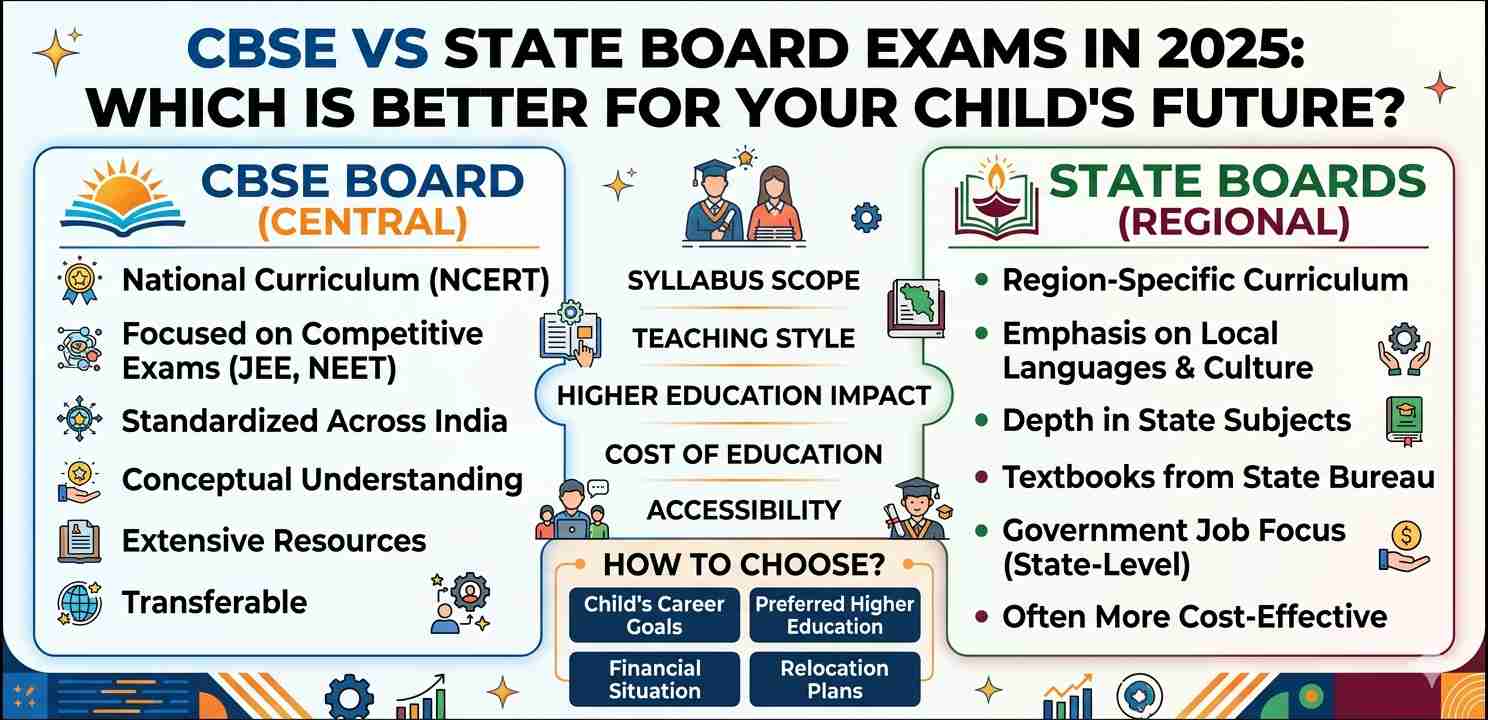
Introduction
Every year, millions of Indian parents face one big question when their child enters Class 6 or prepares for high school: should we go with CBSE or State Board? It’s not a small decision. The board your child studies under can shape the next 10–15 years of their academic and professional life.
CBSE vs State Board is a debate that has been going on for decades, and honestly, it doesn’t have a single right answer. But in 2025, with changes in education policy, NEP implementation, and college entrance exams evolving rapidly, the comparison looks quite different than it did even five years ago.
This article breaks it all down — curriculum, difficulty, college eligibility, career paths, and more. No confusing jargon. No biased opinions. Just practical information that helps you decide.
What Is CBSE and How Does It Work?
CBSE stands for Central Board of Secondary Education. It is a national-level board regulated by the Government of India. Schools affiliated with CBSE follow a standardised curriculum across the entire country, whether the school is in Delhi, Chennai, or a small town in Jharkhand.
CBSE primarily follows NCERT textbooks. The syllabus is designed keeping national-level competitive exams in mind — especially JEE (for engineering), NEET (for medicine), and CUET (for central university admissions).
One of the biggest advantages of CBSE is transferability. If a family moves from one city to another, the child can continue in a CBSE school without missing a beat. This matters a lot for families where parents work in transferable government or corporate jobs.
What Is a State Board and How Is It Different?
State Boards are education boards run by individual state governments. Maharashtra has SSC, Tamil Nadu has Samacheer Kalvi, Uttar Pradesh has UP Board, and so on. Each state has its own syllabus, textbooks, and exam pattern.
State Boards often focus more on regional language, local history, and state-specific content. The medium of instruction may be the regional language, though most State Boards now offer an English medium option as well.
For students who stay in the same state throughout their schooling, State Board works seamlessly. The exams are designed around state-level college admissions and professional courses offered within the state.
CBSE vs State Board: Curriculum and Syllabus Depth
When comparing CBSE vs State Board, the curriculum is often the first point of difference parents notice.
CBSE’s syllabus tends to be more conceptual and application-based. Especially in Science and Mathematics, students are expected to understand why something works, not just what the answer is. This directly prepares students for entrance exams like JEE and NEET.
State Boards, on the other hand, vary widely. Some states like Tamil Nadu and Maharashtra have strong, well-designed syllabi. Others might be comparatively less rigorous. Generally, State Boards focus more on memory-based learning and cover a narrower range of topics.
That said, not every child is aiming for IIT or AIIMS. For students targeting state-level colleges or regional professional courses, the State Board syllabus is perfectly sufficient — and sometimes even better aligned.
CBSE vs State Board: Difficulty Level
This is the part most students are curious about. Is CBSE harder than State Board?
Honestly, yes — in most cases, CBSE is more difficult, especially in subjects like Physics, Chemistry, and Mathematics at the Class 11 and 12 level. The questions require more analytical thinking, and the exam papers are known for being unpredictable.
State Board exams, in many states, are more straightforward. Students who are good at learning from textbooks and reproducing answers tend to score higher in State Boards. This often means a student can get a higher percentage in State Board compared to CBSE for the same level of effort.
But here’s the flip side: a high State Board percentage doesn’t always impress national-level colleges and entrance exam committees in the same way.
CBSE vs State Board: College Admissions in 2025
This is where the CBSE vs State Board comparison gets really important for parents.
National Colleges and Central Universities
For admission to IITs, NITs, AIIMS, Delhi University, JNU, and other central institutions, CBSE students tend to have a natural advantage. Their syllabus is aligned with JEE, NEET, and CUET patterns. State Board students can absolutely crack these exams, but they often need extra coaching to cover the gaps.
Since 2022, CUET (Common University Entrance Test) has become the main gateway for most central universities. CUET is largely based on the CBSE syllabus, which means CBSE students walk in with a familiarity advantage.
State-Level Colleges
For state government colleges, universities, and professional institutes like state engineering and medical colleges, State Board students usually have the upper hand. Admission criteria, merit lists, and reservation policies are designed around State Board results.
So if your child plans to study in their home state, State Board may actually serve them better for local college admissions.
CBSE vs State Board: Career Impact
Does the board you studied under affect your career in the long run?
In most professional careers — engineering, medicine, law, commerce, arts — no one asks about your school board after your bachelor’s degree. What matters is your college, your skills, and your performance in competitive exams.
However, in the early stages — Class 12 marks, entrance exam performance, college quality — the board does play a role. CBSE students who are well-prepared for competitive exams often get into better colleges, which can indirectly shape their career trajectory.
For government jobs, UPSC preparation, and competitive exams at the national level, the analytical approach developed through CBSE education does seem to help. But this is not a hard rule — many top IAS officers and doctors come from State Board backgrounds.
CBSE vs State Board: Cost and Accessibility
CBSE schools, especially in private sectors, tend to be more expensive. Infrastructure, fees, activity costs — it all adds up. Many CBSE schools in urban areas charge anywhere from ₹5,000 to ₹25,000+ per month in fees.
State Board schools, including government-run ones, are far more affordable and accessible, especially in rural and semi-urban areas. For families where budget is a concern, State Board is a practical and sensible choice.
CBSE vs State Board: Which Is Better for Competitive Exams?
If your child is aiming for JEE, NEET, or CUET — CBSE is the more natural fit. The syllabus overlap is significant. CBSE students don’t have to “learn extra” things just for entrance exams; the preparation happens side by side.
State Board students who aim for national-level exams need to invest in additional study material or coaching to bridge the syllabus gap. That’s not impossible — many State Board students clear JEE and NEET every year — but it requires extra effort.
For state-level entrance exams (like MHT-CET in Maharashtra or KCET in Karnataka), State Board students are at a natural advantage since the exams are aligned with the state syllabus.
CBSE vs State Board: Impact on a Child’s Mental Health
This is a point that rarely comes up in parent discussions, but it should.
CBSE’s competitive environment, heavy workload, and pressure-heavy culture — especially in Classes 11 and 12 — can be stressful for average learners. Not every child thrives under that kind of pressure.
State Boards, with a slightly lighter load, may give a child more breathing room to explore hobbies, develop social skills, and manage stress better.
Choosing a board should factor in your child’s temperament, learning pace, and emotional resilience — not just academic ambitions.
Real-Life Scenarios: Who Should Choose What?
Scenario 1: Your family moves between cities frequently, and your child wants to pursue engineering at IIT someday. → CBSE is clearly the better choice.
Scenario 2: You live in a tier-3 town in Maharashtra, budget is limited, and your child wants to become a doctor through a state medical college. → State Board (SSC) makes more practical sense.
Scenario 3: Your child is a strong student, keen on humanities, and wants to pursue journalism or social work. → Either board works fine. Choose based on school quality and fees.
Scenario 4: Your child struggles with studies and needs a less pressured environment. → A good State Board school might be healthier and more supportive.
CBSE vs State Board: Quick Comparison Table
| Parameter | CBSE | State Board |
|---|---|---|
| Curriculum | National, NCERT-based | State-specific |
| Difficulty | Generally higher | Moderate to high (varies) |
| Competitive Exam Alignment | JEE, NEET, CUET | State entrance exams |
| Cost | Higher | Lower |
| Transferability | High | Low |
| Regional Focus | Less | More |
| Scoring Percentages | Moderate | Often higher |
Final Conclusion
The CBSE vs State Board debate doesn’t have a winner that works for everyone. Both boards have real strengths depending on your child’s goals, your family’s location, and your budget.
If your child is academically strong, competitive, and aiming for national-level colleges or entrance exams, CBSE gives them an edge in preparation and syllabus alignment.
If your child is average or above average, plans to study locally, and needs a less stressful academic environment, a good State Board school can provide an equally solid foundation.
What truly matters in the long run is not the board — it’s the quality of teaching, the child’s own effort, and the values instilled at home. No board can replace good parenting, genuine curiosity, and consistent hard work.