 admin@graminguru.in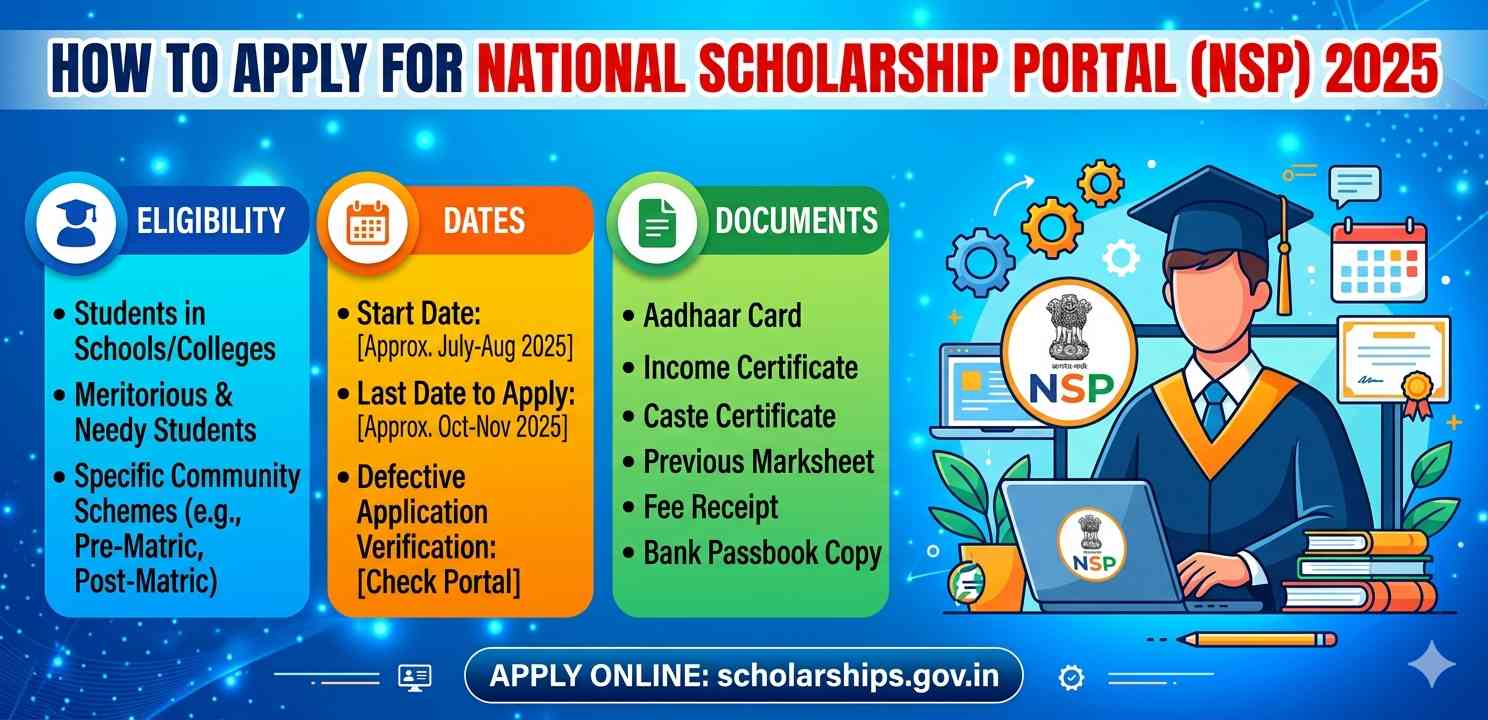
Introduction
Every year, thousands of students across India struggle to find reliable financial support for their education. The good news is that the government has made things a lot easier through one central platform — the National Scholarship Portal. If you’ve heard about it but never quite figured out how to use it, you’re in the right place.
The National Scholarship Portal, commonly known as NSP, is an official government platform that brings multiple scholarship schemes under one roof. Whether you’re a school student, an undergraduate, or pursuing a postgraduate degree, there’s a good chance a scheme on NSP applies to you. In this guide, we’ll walk through everything — from who can apply, to what documents you need, and how the actual registration works step by step.
What Is the National Scholarship Portal?
The National Scholarship Portal was launched by the Ministry of Electronics and Information Technology (MeitY) under the Digital India initiative. It works as a single-window platform where students can discover, apply for, and track central and state government scholarships.
Before NSP existed, students had to apply separately to different departments — which was confusing and often led to duplicate benefits or missed deadlines. The National Scholarship Portal fixed that by creating one unified system.
Today, it hosts more than 100 scholarship schemes from departments like the Ministry of Education, Ministry of Minority Affairs, Ministry of Social Justice, and many more.
Who Can Apply on the National Scholarship Portal?
Basic Eligibility Criteria
Not every student is eligible for every scheme, but most follow a common set of conditions. Here’s what generally applies across scholarships on the National Scholarship Portal:
- You must be an Indian citizen
- You should be studying in a recognized school, college, or university
- Your family’s annual income should fall within the limit set by each scheme (usually ₹1 lakh to ₹8 lakh, depending on the category)
- You must have passed the previous qualifying examination with the required percentage
Different schemes on the National Scholarship Portal have their own specific eligibility conditions. For example, the Pre-Matric scholarship is for Class 9 and 10 students, while the Post-Matric scholarship covers Class 11 onwards, including degree and diploma courses.
Category-Based Scholarships
The National Scholarship Portal has schemes for SC, ST, OBC, minorities, and differently-abled students. There are also merit-based scholarships that are open to all categories, like the Central Sector Scheme for College and University Students.
So even if you belong to the general category, don’t assume NSP has nothing for you — check the full list.
Important Dates for NSP 2025
Every year, the National Scholarship Portal follows a fixed academic cycle. For the 2025 session, the registration window typically opens in July or August and closes around October or November.
Here’s what the general timeline looks like:
- Registration Start: July–August 2025
- Last Date to Apply: October–November 2025
- Institute Verification Deadline: Usually 15–30 days after the student deadline
- Renewal Applications: Separate window, usually same period
It’s important to check the official NSP portal for exact dates because they can shift slightly each year. Don’t rely on third-party websites for this — always verify at scholarships.gov.in.
Documents Required for National Scholarship Portal Registration
This is where a lot of students get stuck. The National Scholarship Portal requires specific documents, and submitting the wrong format or missing one can delay your application.
Here’s what you’ll generally need:
Identity and Address Proof
- Aadhaar card (mandatory — linked to your mobile number)
- Bank account details (the account should be in your name)
Academic Documents
- Marksheet of the last qualifying exam
- Bonafide certificate or admission letter from your current institution
- Fee receipt from the institute
Income Proof
- Income certificate issued by a competent authority (Tehsildar or equivalent)
Category Certificate (if applicable)
- Caste certificate for SC/ST/OBC students
- Minority self-declaration or certificate for minority applicants
Before starting the National Scholarship Portal application, make sure all your documents are scanned clearly. Blurry images or incomplete documents are a common reason for rejection.
Step-by-Step Guide to Apply on the National Scholarship Portal
Now let’s get to the actual process. Here’s how to register and apply on the National Scholarship Portal from scratch.
Step 1: Visit the Official Website
Go to scholarships.gov.in. This is the only official URL for the National Scholarship Portal. Avoid any other site claiming to help you register.
Step 2: New Registration
Click on “New Registration” on the homepage. You’ll be shown a set of guidelines and undertakings. Read them carefully, then check the boxes and proceed.
Step 3: Fill in Basic Details
Enter your name (as it appears on your Aadhaar), date of birth, mobile number, email ID, and state. You’ll receive an OTP on your mobile for verification.
Step 4: Get Your Application ID and Password
After OTP verification, the National Scholarship Portal will give you a temporary Application ID and password. Save this immediately — you’ll need it to log in.
Step 5: Complete the Application Form
Log in with your credentials. You’ll now fill in:
- Personal details
- Educational details (current course, institute, year)
- Bank account details (IFSC code, account number)
- Upload documents
Take your time here. Mistakes in bank details especially can cause the scholarship amount to go into the wrong account or get rejected.
Step 6: Submit and Note Your Registration Number
Once submitted, note down your final registration number. You can use this to track your application status on the National Scholarship Portal anytime.
How to Renew Your NSP Scholarship
If you received a scholarship last year and want to continue, you don’t apply fresh — you renew. The National Scholarship Portal has a separate “Renewal” login. You’ll need to provide updated academic documents and confirm that you’re still studying in the same or a higher course.
The renewal process is simpler than fresh registration, but don’t skip it — failing to renew means losing your scholarship for that year.
Common Mistakes to Avoid
A lot of applications on the National Scholarship Portal get rejected not because of eligibility issues but because of avoidable errors. Here are a few things to watch out for:
- Name mismatch: Your name on the form should exactly match your Aadhaar and bank account
- Wrong institute code: Each registered institution has a specific NSP code — don’t guess it
- Uploading wrong documents: Read what each field asks for before uploading
- Applying under the wrong scheme: There are many schemes on NSP; pick the one that fits your category and level of education
- Missing institute verification: Even if you complete your form, your institute has to verify it. Follow up with them
Tracking Your Application on NSP
Once applied, you can log back into the National Scholarship Portal and check your status under “Check Your Status.” The stages you’ll see include: submitted, institute verified, district verified, and payment processed.
If your application is stuck at one stage for too long, contact your institution’s nodal officer or the NSP helpline.
Final Conclusion
The National Scholarship Portal is genuinely one of the most useful platforms the Indian government has built for students. It’s not perfect — the process can feel overwhelming at first — but once you understand the flow, it’s quite manageable.
To summarize: check your eligibility based on your category and course, gather all documents before you start, register on the official NSP site before the deadline, and make sure your institute completes the verification. Don’t wait until the last week — technical issues and long queues are common near the deadline.
For any updates on new schemes or official notifications, always refer to the Ministry of Education’s official portal or the NSP site directly.