 admin@graminguru.in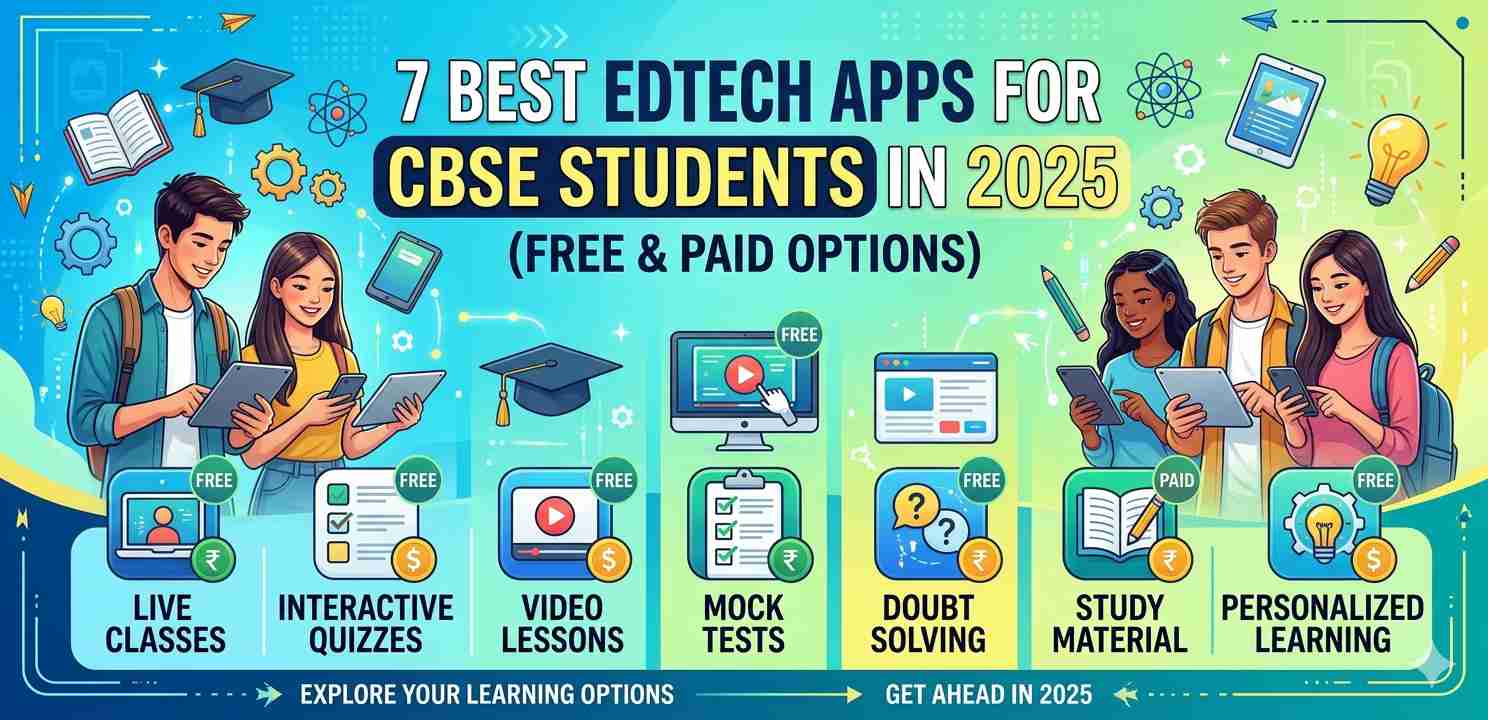
Introduction
Every CBSE student has been there — staring at a chapter on Organic Chemistry or Trigonometry at 10 PM, totally lost, with no teacher to call. That gap is exactly where EdTech apps for CBSE students have quietly changed the game.
Over the last few years, mobile learning has gone from a novelty to an actual necessity. Whether you are in Class 6 trying to understand fractions or in Class 12 preparing for board exams, there is likely an app built just for your needs. And the good news? Many of them are either free or genuinely affordable.
This guide covers 7 of the best EdTech apps for CBSE students in 2025 — covering both free and paid options — so you can pick the one that fits your learning style and budget.
Why CBSE Students Need EdTech Apps in 2025
The CBSE syllabus is detailed, competitive, and honestly a bit intense. Textbooks are helpful, but they do not always explain why something works the way it does. That is where a good app steps in.
EdTech apps offer video explanations, practice tests, doubt-solving features, and even AI-based feedback. For students preparing for boards or competitive exams like JEE and NEET, this kind of support can make a real difference.
Plus, using a phone or tablet for studying means you are not stuck at a desk. You can revise on a bus, during lunch, or before bed.
1. BYJU’S – Best for Visual Learners
BYJU’S is probably the most well-known name in EdTech apps for CBSE students. It has been around long enough to build a solid reputation, especially for Classes 4 to 12.
What Makes It Stand Out
The app uses animated videos and 3D visuals to explain concepts. A chapter like the Structure of an Atom, which feels impossible from a textbook, suddenly makes sense when you watch it come alive on screen.
BYJU’S also has chapter-wise tests and performance tracking. Parents can see how their child is doing, which is a feature schools often lack.
Pricing: Free trial available. Full access requires a paid subscription, which starts around ₹2,500/month depending on the class.
Best for: Visual learners in Classes 6–12 who struggle with abstract concepts in Science and Maths.
2. Vedantu – Best for Live Classes
If you prefer learning with an actual teacher rather than a recorded video, Vedantu is one of the top EdTech apps for CBSE students right now.
Live Learning That Actually Feels Like a Class
Vedantu runs live online classes where students can ask questions in real time. Teachers use a digital whiteboard, and sessions are recorded if you miss one.
The app also has WAVE, their own AI tool that analyzes student attention and engagement during live sessions. It is a bit different from most apps and adds a layer of accountability.
Pricing: Many free classes are available. Premium plans start around ₹1,200/month for specific subjects.
Best for: Students who need teacher interaction and cannot attend coaching classes nearby.
3. Toppr – Best All-in-One App
Toppr tries to do everything in one place — video lessons, practice questions, mock tests, and doubt solving. For CBSE students juggling boards and entrance exam prep, that combination is useful.
Features Worth Noting
The adaptive practice engine in Toppr adjusts difficulty based on your performance. So if you are weak in Integration but strong in Algebra, the app focuses more time on what you actually need.
Doubt-solving is also available 24/7, which is honestly one of the better features here.
Pricing: Free version exists with limited access. Full plan costs around ₹800–₹2,000/month depending on the package.
Best for: Class 10 and 12 students who want one app for everything.
4. Khan Academy – Best Free Option for CBSE Students
Khan Academy deserves a special mention for one reason: it is completely free. No paywalls, no premium tiers, no ads. Every single resource is accessible to anyone.
Does It Match the CBSE Syllabus?
Mostly yes, especially for Maths and Science. The content is organized by topic rather than CBSE chapters, so you may need to search around a bit. But the quality of explanations is genuinely excellent.
Khan Academy is one of the best EdTech apps for CBSE students on a tight budget. It also works on low-end Android phones, which is a practical advantage.
Pricing: Free. Always.
Best for: Students of any class looking for conceptual clarity without spending anything.
5. Meritnation – Best for NCERT-Aligned Content
Meritnation is built specifically around the NCERT syllabus, which is the backbone of CBSE exams. If your goal is to score well in board exams, this kind of alignment matters.
NCERT Solutions and Live Tests
The app has detailed NCERT solutions, chapter summaries, and live tests that follow the actual board exam pattern. It also has a homework help feature where you can submit questions and get answers from experts.
For Class 10 and 12 students, the past-paper practice section is particularly useful.
Pricing: Basic access is free. Paid plans start around ₹600/month.
Best for: Class 9–12 students focused entirely on board exam preparation.
6. Doubtnut – Best for Quick Doubt Solving
Ever been stuck on a Maths problem for 20 minutes and had no one to ask? Doubtnut was built for that exact situation.
How It Works
You take a photo of the question with your phone camera, and the app gives you a step-by-step video solution within seconds. It works surprisingly well for Maths, Physics, and Chemistry.
Doubtnut is one of the most practical EdTech apps for CBSE students because it solves a very specific, very real problem. And a large part of it is free.
Pricing: Free for most features. Premium plans available for additional content.
Best for: Any student who frequently gets stuck on numerical problems.
7. Embibe – Best for JEE/NEET + CBSE Preparation
If you are in Class 11 or 12 and aiming for engineering or medical entrance exams alongside boards, Embibe is worth your attention.
AI-Powered Learning
Embibe uses AI to analyze not just what you answered but how you approached problems. It gives feedback on things like time management per question and accuracy patterns — the kind of data that helps you improve strategically.
The content covers both the CBSE syllabus and JEE/NEET topics, making it efficient for students preparing for multiple exams simultaneously.
Pricing: Free tier available. Paid plans start around ₹1,500/month.
Best for: Class 11–12 students preparing for competitive exams along with CBSE boards.
Free vs Paid EdTech Apps for CBSE Students: Which Should You Choose?
This really comes down to what you need.
If you just want to understand concepts better and cannot spend money right now, Khan Academy and the free tiers of Doubtnut or Meritnation are genuinely good. They cover enough ground to be helpful.
If you are in Class 12 or preparing for competitive exams, investing in a paid plan from Vedantu, BYJU’S, or Embibe may give you the structured support and live interaction that free apps cannot fully replicate.
Either way, using EdTech apps for CBSE students consistently — even 30 minutes a day — tends to show results over time.
Tips for Getting the Most Out of These Apps
Using five apps at once is a common mistake. Pick one or two that match your goals, and use them regularly.
Most apps offer a free trial. Use it honestly — actually study for a week before deciding if the paid version is worth it.
Set specific goals before opening any app. “I will finish Chapter 4 of Chemistry” is more useful than scrolling through random videos.
Also, check if your school provides any app subscriptions free of cost. Many CBSE schools have tie-ups with platforms like Vedantu or Meritnation that students simply never use.
Internal Links
- How to Prepare for CBSE Class 12 Board Exams Without Coaching
- Best Android Apps for Students to Stay Focused While Studying
External Resources
- NCERT Official Website — Download NCERT textbooks and solutions for free
- Khan Academy — Free learning for all subjects and grade levels
Final Conclusion
The right EdTech app for CBSE students does not need to be the most expensive one. It needs to be the one you will actually open and use every day. Whether that is a free app like Khan Academy or a structured program like BYJU’S depends entirely on your goals, your class, and how you learn best.
The 7 apps covered here are all reliable, well-built options in 2025 — some free, some paid, but each solving a real problem for real students. Start with the one that matches your immediate need, whether that is doubt solving, live teaching, or board exam practice, and build from there.