 admin@graminguru.in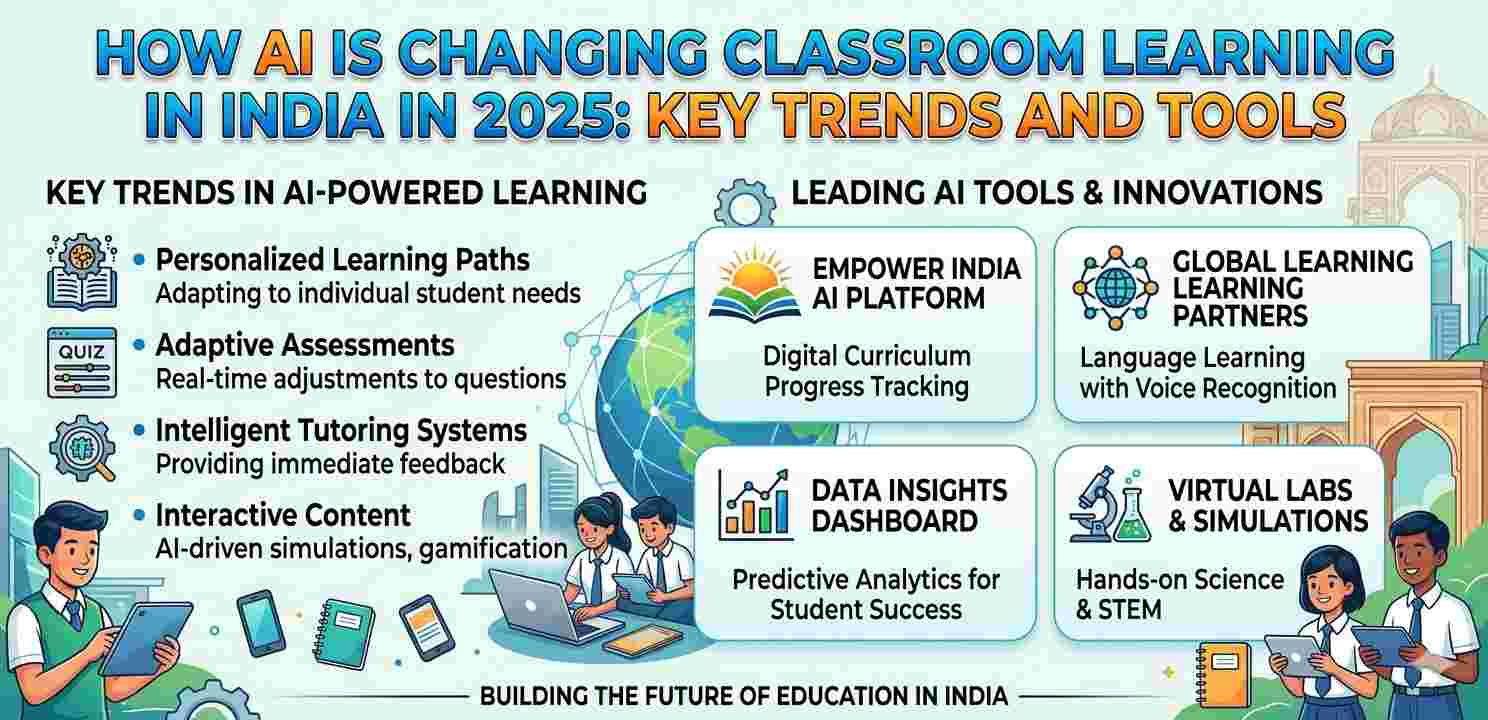
Introduction
Education in India is going through one of its biggest shifts in decades. Walk into many schools today — especially in urban areas — and you will notice something different. Tablets on desks. Smart boards on walls. Teachers using apps to track student progress in real time. AI in classroom learning in India is no longer a concept from a tech conference. It is slowly becoming part of everyday school life.
This does not mean robots are teaching children. Not at all. What it means is that software powered by artificial intelligence is helping teachers do their jobs better, helping students learn at their own pace, and making education a little more personal than it used to be.
In 2025, this shift has become more visible and more measurable. Let us look at what is actually happening on the ground.
What Does AI in the Classroom Actually Mean?
classroom learning in India Before going further, it helps to be clear about what we mean. AI in classroom learning does not always mean fancy hardware or expensive setups. Sometimes it is as simple as a student using an app on a phone that adjusts the difficulty of questions based on how well they are doing.
The basic idea is that a software system learns from data — from how a student answers questions, how long they spend on a topic, where they make mistakes — and then uses that to guide what comes next.
This kind of personalized experience was very hard to deliver in a classroom of 40 students. AI makes it more possible.
The Personalized Learning Revolution
One of the biggest changes brought by AI in classroom learning in India is personalized learning. Traditional classrooms in India have always had one teacher for many students. The teacher moves at a fixed pace. Some students fall behind. Others get bored because the content is too easy for them.
AI-based platforms like BYJU’S, Vedantu, and Toppr have been working on this problem for years. By 2025, their systems have become much smarter. They can identify exactly which concept a student is weak in and suggest targeted practice problems. The student does not have to wait for the next class or feel embarrassed to ask the teacher again.
This has been especially useful in Tier 2 and Tier 3 cities where access to experienced tutors has always been limited. A student in a small town in Rajasthan now has access to similar quality practice and feedback as a student in a metro city.
AI Tools Commonly Used in Indian Classrooms in 2025
1. Adaptive Learning Platforms
BYJU’S Learning App remains one of the most widely used tools. It uses AI to track learning patterns and adjust content accordingly. Similarly, Khan Academy (available in multiple Indian languages now) uses AI to recommend what to study next.
These tools have improved significantly. The recommendation engine is sharper, the content library is broader, and the interface works well even on mid-range Android phones — which matters in India where most students access content through a smartphone.
2. AI-Powered Assessment Tools
Teachers in many private schools are now using platforms like Extramarks and Educomp. These platforms can auto-generate tests, evaluate short written answers using natural language processing, and give detailed reports on class performance.
This saves teachers hours every week. Instead of manually correcting 40 test papers, a teacher gets a report that tells them which question most students got wrong and why. That information helps them reteach the concept more effectively.
3. Language and Translation Tools
India has 22 official languages. This has always been a challenge for education. AI in classroom learning in India is addressing this through real-time translation and multilingual content tools. Some platforms now offer math and science content in regional languages like Tamil, Telugu, Marathi, and Bengali, with AI doing the translation and even the voiceover.
How Teachers Are Adapting
From Lecturers to Facilitators
The role of the teacher is changing. In schools that have adopted AI tools, teachers are spending less time on repetitive tasks — like writing notes on the board or correcting the same type of mistake over and over. Instead, they are spending more time on discussions, experiments, and helping students who need extra support.
This is a significant cultural shift in Indian education. The traditional model placed the teacher at the centre as the sole source of knowledge. AI is shifting that balance. The teacher becomes a guide, and the AI platform becomes the practice partner.
Some teachers have found this difficult to adapt to. Others have embraced it enthusiastically. Training and support from schools plays a big role here.
Teacher Training Programs in 2025
The National Council of Educational Research and Training (NCERT) and several state education boards have rolled out digital literacy programs for teachers. In 2025, many of these programs include modules on how to use AI in classroom learning tools effectively.
The goal is not to make every teacher a tech expert. The goal is to make them comfortable enough to use these tools and to understand what the data is telling them about their students.
Government Initiatives Driving AI in Education
The National Education Policy (NEP) 2020 laid the groundwork for integrating technology into Indian schools. By 2025, several of its recommendations have been implemented in various states.
The PM eVIDYA program expanded its reach significantly. Digital Infrastructure for Knowledge Sharing (DIKSHA) — the government’s own education platform — has added AI-based features including personalized content feeds and learning analytics for teachers.
Some states like Karnataka, Maharashtra, and Tamil Nadu have run pilot programs specifically testing AI in classroom learning in India in government schools. Early results have been encouraging, particularly for math and reading comprehension. You can read more about these initiatives on DIKSHA’s official portal.
Challenges That Still Exist
It would not be honest to talk about AI in education without mentioning the very real challenges.
The Digital Divide
Not every student in India has access to a smartphone or a stable internet connection. While urban schools are adopting AI tools quickly, many rural government schools are still working with basic infrastructure. The benefits of AI in classroom learning in India are not yet evenly distributed.
In states like Bihar, Jharkhand, and parts of Uttar Pradesh, even electricity supply to schools is inconsistent. AI-powered tools cannot do much without a reliable power source and internet.
Data Privacy Concerns
When a student uses an AI learning platform, the platform collects a lot of data. How that data is stored, who can access it, and how it is used are important questions. India passed its Digital Personal Data Protection Act in 2023, and by 2025, edtech companies are required to follow stricter guidelines around student data. But enforcement is still a work in progress.
Over-reliance on Screens
There is also the concern — raised by many parents and educators — that too much screen time is not healthy for young children. The best schools are trying to find a balance: using AI tools for targeted practice while still maintaining physical activity, group work, and human interaction in the classroom.
What Students Are Actually Experiencing
Talk to students using AI-based learning tools regularly, and you get a mixed but mostly positive picture.
Many students say they like being able to practice at their own speed. They do not feel judged by an app the way they might feel nervous raising their hand in class. Some say the instant feedback is the most useful part — knowing right away if an answer was wrong and why, rather than waiting days for a corrected test paper.
At the same time, some students miss the human connection. Learning with a teacher who knows your name, knows your family situation, knows why you were distracted last week — that kind of relationship matters. AI cannot replicate it.
The best outcomes seem to come when both exist together. AI handles the practice and feedback loop. The teacher handles the relationships and the nuance.
The Road Ahead for AI in Classroom Learning in India
Looking at where things are heading, AI in classroom learning in India will only grow more prominent over the next few years. Several things are likely to happen.
More vernacular language support will come. As natural language processing improves, AI tools will become genuinely useful in more Indian languages, not just Hindi and English.
AI tutors will get more conversational. Some platforms are already experimenting with chatbot-style tutors that can answer student questions in natural language. By 2026 or 2027, these could be quite capable.
Assessment will become smarter. Instead of just testing whether a student got the right answer, AI systems will start tracking the process — how a student approached a problem, where they hesitated, what kind of mistakes they made. That kind of insight can really change how teachers intervene.
For more on global trends in AI and education, UNESCO’s AI in Education resource offers useful context.
Final Conclusion
The story of AI in classroom learning in India in 2025 is neither a perfect success story nor a cautionary tale. It is a work in progress, like most meaningful change tends to be.
What is clear is that the direction is set. AI tools are already helping students learn more effectively in many parts of the country. They are helping teachers work smarter and giving students in smaller towns access to quality practice that was previously unavailable to them.
The challenges — digital access gaps, data privacy, screen fatigue — are real and need continued attention. But the potential is equally real. If this technology is rolled out thoughtfully, with teachers trained properly and students’ wellbeing kept at the centre, AI could genuinely help India’s education system serve its enormous and diverse student population better.