 admin@graminguru.in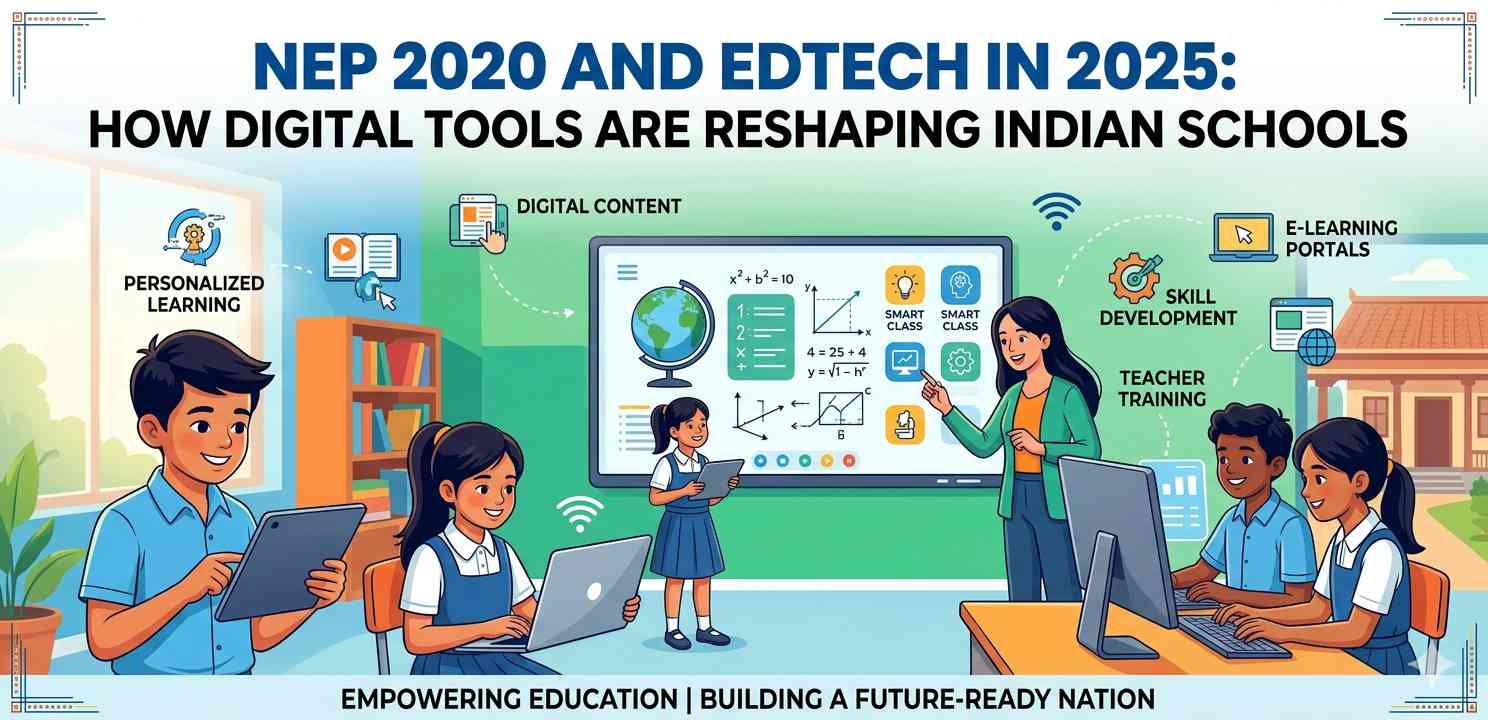
Introduction
India’s education system has been going through a quiet but very real transformation since 2020. The National Education Policy, better known as NEP 2020, arrived at a time when schools were already struggling with the shock of COVID-19. And slowly but surely, over the past few years, something interesting has happened — NEP 2020 and EdTech have started working together in ways that are genuinely changing how children learn.
This isn’t just about putting projectors in classrooms. It goes deeper than that. It’s about rethinking what school should feel like, what skills matter, and how technology can actually help — not just look impressive. In 2025, the results are becoming visible in government schools in Rajasthan, private institutions in Pune, and even small-town coaching centres in Bihar.
If you’re a parent, teacher, school administrator, or just someone curious about where Indian education is heading, this article will give you a clear picture of what’s really happening on the ground.
What NEP 2020 Actually Wants From Schools
Before understanding the technology piece, it helps to know what NEP 2020 is actually asking schools to do differently.
The policy moves away from rote learning and marks-focused teaching. It pushes for critical thinking, creativity, and understanding over memorisation. It introduces a new 5+3+3+4 structure that replaces the old 10+2 format. It also strongly emphasises mother-tongue or regional-language instruction in the early years.
For all of this to work at scale — across thousands of schools, in dozens of languages, with varying teacher capacities — digital tools become not just helpful but almost necessary. That’s where NEP 2020 and EdTech start to make real sense together.
How EdTech Platforms Are Aligning With NEP 2020 Goals
Personalised Learning Is Now Possible
One of the biggest promises of NEP 2020 and EdTech coming together is personalised learning. Traditional classrooms have 40–60 students with one teacher. It’s practically impossible for that teacher to track where each child is struggling.
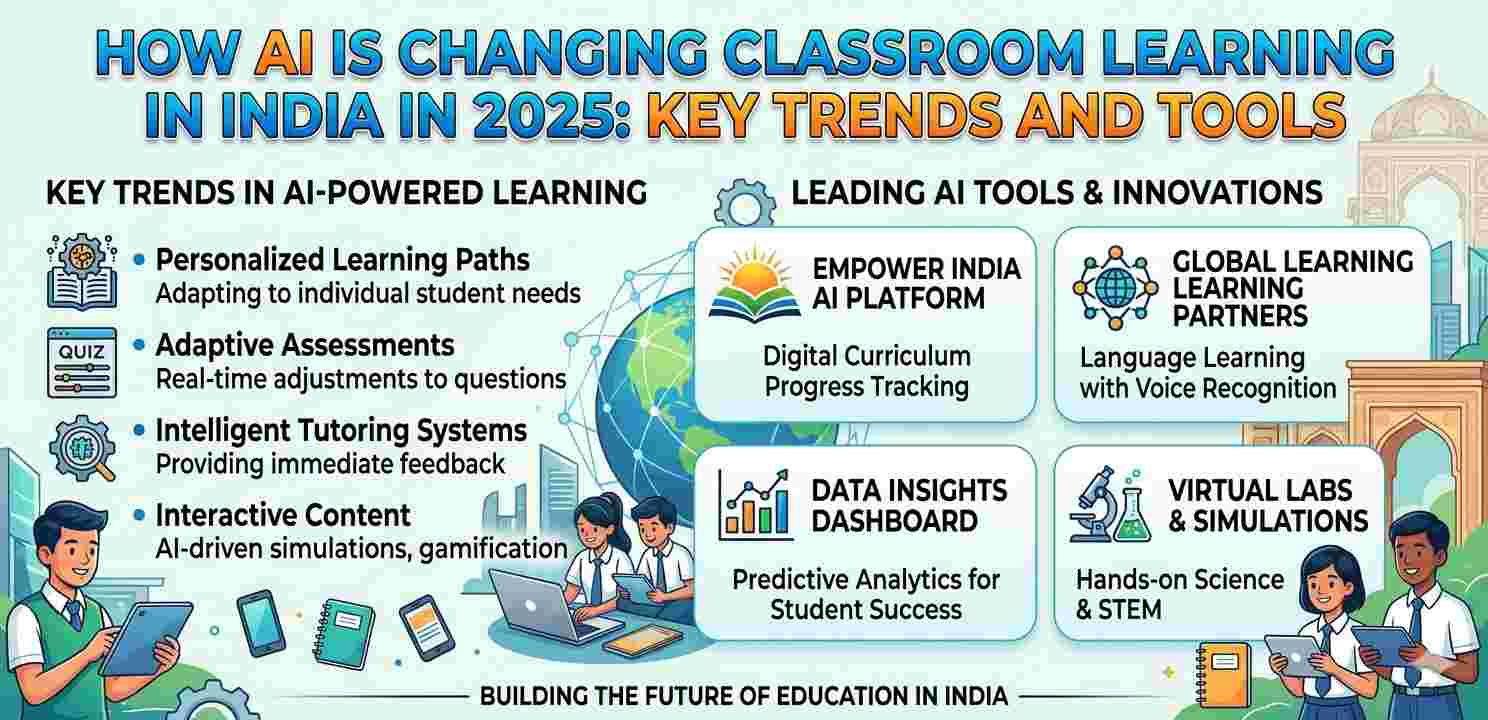
EdTech platforms like DIKSHA (developed by the government), BYJU’S, and Vedantu now use adaptive learning algorithms. These tools watch how a student is answering questions — how fast, how often they retry, where they pause — and adjust content accordingly.
A Class 6 student in Nagpur who’s strong in Science but weak in fractions will get more practice problems on fractions automatically. No manual tracking needed.
Regional Language Content Is Expanding
NEP 2020 strongly recommends teaching in the child’s home language until at least Class 5. This was always the policy intention, but content availability in regional languages was a huge gap.
In 2025, that gap is narrowing. The DIKSHA portal now carries lakhs of learning resources across 20+ Indian languages. Private EdTech companies have also invested in Tamil, Telugu, Kannada, Bengali, and Marathi content, partly because the market demanded it and partly because NEP 2020 and EdTech alignment became a selling point for schools.
Smart Classrooms in Government Schools: What’s Actually Happening
The phrase “smart classroom” often brings to mind expensive private schools with interactive whiteboards and fast Wi-Fi. But the picture in 2025 is more nuanced.
PM e-VIDYA and Its Real Impact
PM e-VIDYA, launched under the National Education Policy framework, has made significant ground. It covers DTH TV channels (one per state), online portals, and radio programming — all designed to reach students without reliable internet.
In states like Odisha and Chhattisgarh, where internet connectivity is still patchy in tribal areas, these alternate delivery channels matter. A student watching a maths lesson on a government TV channel at 10 AM is still experiencing the spirit of NEP 2020 and EdTech — just not through a smartphone app.
Low-Cost Tablets and the PM Vidyalaxmi Scheme
Several state governments have distributed low-cost tablets to secondary school students in 2024–25. These come preloaded with NCERT content, state board syllabi, and offline learning apps.
The offline functionality is important. Not every student has 4G access at home. Preloaded content means a student in a small village can still access quality material without burning mobile data.
Teachers: The Most Important Part of the EdTech Equation
Here’s something that often gets missed in discussions about NEP 2020 and EdTech: none of it works if teachers aren’t on board and well-trained.
NISTHA Online Training
The government’s NISTHA programme (National Initiative for School Heads and Teachers Holistic Advancement) has moved significantly online. As of 2025, over 30 lakh teachers have completed at least one digital training module.
These aren’t just how-to-use-a-tablet tutorials. The modules cover pedagogy, assessment design, and how to use EdTech tools in alignment with the new curriculum frameworks under NEP 2020.
Teacher Reluctance Is Real — and Understandable
Not every teacher is enthusiastic. A 52-year-old Hindi teacher in a Madhya Pradesh government school, who has been doing this for 25 years, doesn’t necessarily want to change how she teaches just because a new policy says so.
The honest truth about NEP 2020 and EdTech implementation is that the human side is still the hardest part. Training, support, and time for adjustment matter enormously. Schools that have seen real improvement are almost always ones where the principal actively champions the change.
Assessment Reform: Moving Away From Annual Exams
NEP 2020 proposes a shift from big, high-stakes annual exams to continuous, competency-based assessment. EdTech is helping make this practical.
AI-Powered Assessment Tools
Platforms like iDream Education and Extramarks now offer AI-based assessment systems that track student progress across the year. Teachers get weekly reports. Parents get alerts. Students can see their own progress in real time.
This kind of continuous feedback loop is very much in the spirit of what NEP 2020 and EdTech are trying to achieve together — moving from “you failed the final exam” to “here’s where you’ve been improving and where you need help.”
The Vocational and Skill Education Push
One of the genuinely new things in NEP 2020 is the push for vocational education starting at the middle school level. By Class 9, students should have exposure to at least one skill — coding, carpentry, plumbing, farming, or others.
EdTech has responded here too. Platforms like Skill India Digital and various state-specific portals offer video-based vocational courses. Some schools have partnered with local ITIs (Industrial Training Institutes) to provide blended learning — partly in-person, partly through an app.
This integration of NEP 2020 and EdTech in the vocational space is still early-stage, but it’s growing steadily.
Challenges That Still Exist in 2025
It would be unfair — and frankly misleading — to paint this as a fully smooth success story. There are real, ongoing challenges.
The Digital Divide Hasn’t Disappeared
Urban private school students and rural government school students are still experiencing very different versions of NEP 2020 and EdTech in 2025. The infrastructure gap — internet, devices, electricity — remains significant in parts of Uttar Pradesh, Bihar, Jharkhand, and the Northeast.
Content Quality Varies Widely
Not everything on EdTech platforms is good quality. Some content is rushed, some is just digitalised versions of the same rote-learning approach NEP 2020 is trying to replace. Putting bad teaching on a tablet doesn’t make it better.
Parental Awareness Is Uneven
In tier-2 and tier-3 cities, many parents still equate education quality with the thickness of the textbook and the length of homework. Explaining that a child is “learning through an app” can feel suspicious to parents who weren’t educated that way. This cultural shift takes time.
What’s Actually Working: Stories From the Ground
In Hyderabad, a chain of budget private schools started using DIKSHA content combined with offline tablets in 2023. By 2025, their Class 5 reading scores in Telugu improved by 18% compared to the previous cohort.
In Rajasthan, a district education officer mandated that all government school teachers complete at least two NISTHA modules per term. Teacher-reported confidence in using digital tools went up considerably in that district.
These aren’t massive headline stories. They’re small, ground-level wins — but they’re real. And that’s typically how sustainable change in education actually looks.
Final Conclusion
The story of NEP 2020 and EdTech in India isn’t a dramatic revolution. It’s a gradual, sometimes messy, but genuinely meaningful shift in how schools operate and how students learn.
The policy provided the vision — personalised learning, regional language instruction, skill development, continuous assessment. EdTech is providing some of the tools to make that vision practical at scale. Platforms are adapting. Teachers are slowly getting more confident. Content in regional languages is growing. Government schemes are extending reach to students who previously had very little access to quality material.
There are still real gaps: infrastructure inequality, inconsistent content quality, and the fundamental challenge of changing human habits in large institutions. None of these will be solved overnight.
But in 2025, if you walk into a well-functioning Indian school — government or private — you’re more likely than ever to see something that looks genuinely different from a decade ago. Students are engaging with content, not just copying it. That is the real promise of NEP 2020 and EdTech working together.