 admin@graminguru.in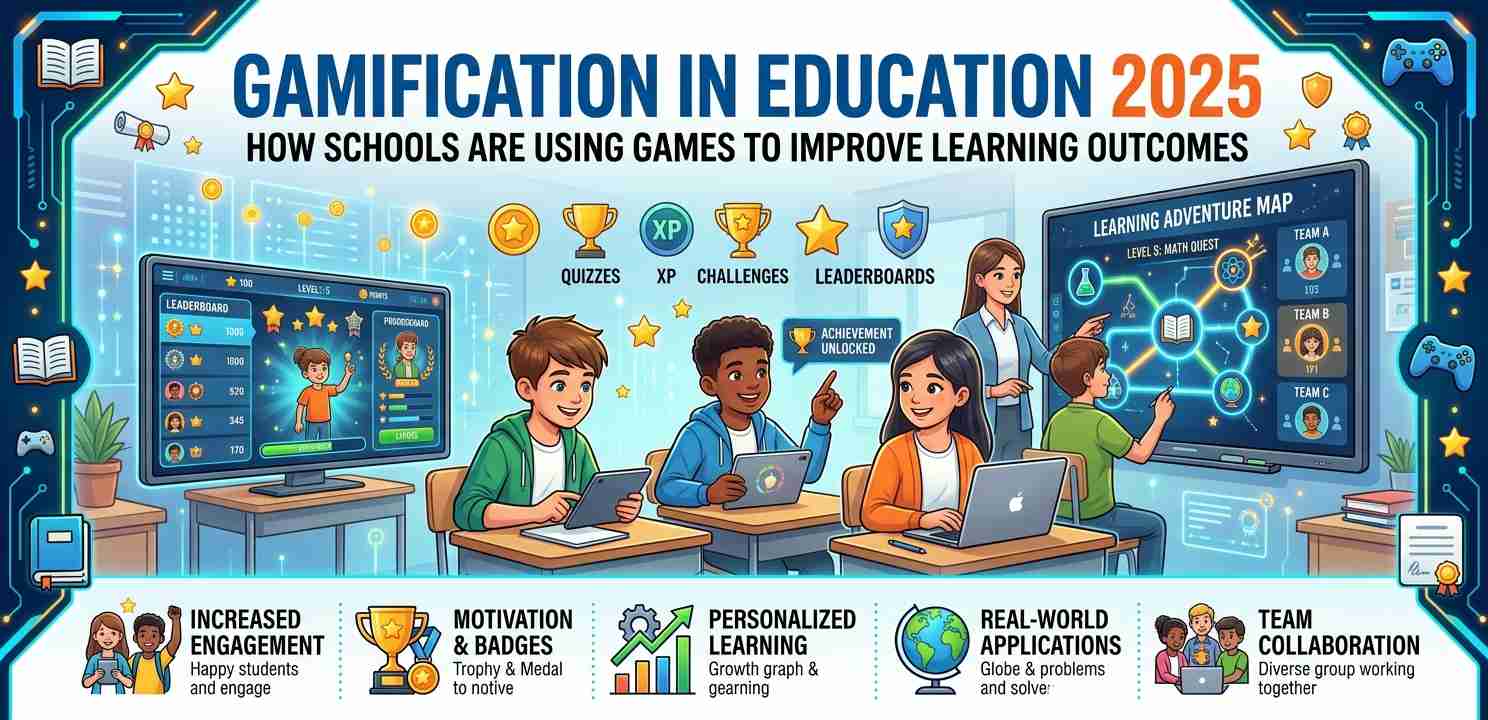
Introduction
If you’ve ever watched a child spend three hours on a video game without getting bored, you’ve probably thought — why can’t school feel like that? That question is actually behind one of the biggest shifts happening in classrooms right now. Gamification in education is no longer a buzzword. In 2025, it’s a real, practical strategy that teachers and school administrators are using every day to make learning stick.
This article breaks down exactly what gamification in education means, why it works, and how schools across the world are putting it into practice with measurable results.
What Does Gamification in Education Actually Mean?
A lot of people confuse gamification with playing video games in class. That’s not quite right.
Gamification in education means applying game-like elements — such as points, badges, leaderboards, levels, and challenges — to learning activities that are not games themselves. The subject could be math, history, science, or language arts. The game mechanics are just the wrapper that makes engagement easier.
Think of it this way: when a student earns a “Reading Champion” badge after finishing five books, or sees their name move up a class leaderboard after acing a quiz, they feel a small but real sense of achievement. That feeling keeps them coming back.
Why Schools Are Taking Gamification Seriously in 2025
The data from recent years has been hard to ignore. Schools that introduced structured gamification in education reported higher classroom participation, fewer incomplete assignments, and better retention of material — especially among students who traditionally struggled.
There’s also a generational factor. Today’s students have grown up with interactive digital environments. Passive, lecture-based instruction often doesn’t hold attention the way it once did. Gamification in education meets students where they already are, psychologically speaking.
Beyond engagement, researchers found that game-based learning reduces test anxiety. When a student is practicing through a quiz “game,” the pressure feels different than a formal test — even if the content is identical.
Core Elements Schools Use to Gamify the Classroom
Points and Progress Tracking
One of the simplest ways schools implement gamification in education is through a points system. Students earn points for completing homework on time, participating in class discussions, or helping a classmate. Teachers track these visually — sometimes on a classroom board, sometimes through a digital platform.
Progress bars work especially well for younger students. Seeing a visual bar fill up gives an immediate sense of movement and reward that abstract grades don’t always provide.
Badges and Achievements
Digital badges work similarly to how scouts earn merit patches. A student who masters multiplication gets a badge. One who reads across five different genres gets another. These aren’t just decorative — they serve as visible markers of actual competency.
Many schools connect badges to real privileges or recognition, which gives them practical value beyond a digital icon.
Leaderboards (Used Carefully)
Leaderboards can motivate competitive students but can also discourage those who consistently find themselves near the bottom. Schools using gamification in education thoughtfully often use personal leaderboards — where students compete with their own past scores rather than against each other.
This small shift turns competition into self-improvement, which is psychologically healthier and more inclusive.
Levels and Unlockables
Some teachers design their curriculum so students must “level up” to access advanced content. A student who completes foundational topics unlocks harder challenges, optional projects, or creative tasks. This pacing method keeps fast learners engaged while ensuring others don’t get left behind.
Real Classroom Examples of Gamification in Education
Elementary Schools: Story-Based Learning Quests
In many primary schools, teachers are building learning “quests” where students take on characters in a narrative. A science unit might be framed as a mission to save a fictional planet by solving real chemistry problems. The story gives context, and the challenges reinforce curriculum goals.
Teachers report that even reluctant learners become invested when there’s a narrative thread connecting the activities.
Middle Schools: Classroom Economy Systems
Several middle schools have implemented classroom economies as part of gamification in education. Students earn “currency” for good academic behavior and can spend it on small rewards like homework passes, extra computer time, or choosing their seat. They also learn concepts like budgeting and saving — making the gamification do double duty.
High Schools: Simulation-Based Assessment
In high school settings, gamification in education often takes the form of simulations. A history class might run a model United Nations where students roleplay as diplomats. A business class might manage a virtual company for a semester. These aren’t just fun — they require applying real knowledge under realistic (if fictional) pressure.
Digital Platforms That Are Leading the Way
Several platforms have made gamification in education much easier to implement without requiring teachers to build everything from scratch.
Kahoot! remains widely used for quiz-based review sessions. Its fast-paced format and competitive structure work well for revision before exams.
Classcraft goes deeper, turning the entire classroom into an RPG-style experience where students build characters and earn abilities through good behavior and academic effort.
Duolingo — while primarily a language app — has influenced how many schools think about reward loops, streaks, and daily goals as motivational tools inside language learning curricula.
Teachers note that the best platforms are those that integrate naturally with existing lesson plans rather than requiring entirely separate instruction time.
The Science Behind Why Gamification in Education Works
Game mechanics trigger specific psychological responses. Points and rewards activate the brain’s dopamine system — the same pathway involved in motivation and habit formation. When a student earns a badge or sees their score improve, it reinforces the behavior that led to that outcome.
Importantly, gamification in education also builds what psychologists call intrinsic motivation over time. Initially, students may be driven by external rewards (a badge, a leaderboard rank). But repeated success in a subject tends to build genuine interest and confidence.
According to research cited by the American Psychological Association, engagement-based learning interventions significantly improve long-term retention when designed thoughtfully rather than applied superficially.
Failure also works differently in gamified settings. In a game, failing a level means trying again. In traditional schooling, a failing grade can feel permanent and discouraging. Gamification in education reframes failure as a normal part of progress, which builds resilience.
Challenges and Honest Limitations
Gamification in education is not a magic fix. Teachers and schools that rush implementation without clear goals often see short-term excitement followed by dropout.
Some students find competitive elements stressful rather than motivating. Others learn to “game the system” — collecting points without genuine learning. And designing effective gamified learning takes real effort from educators who are already stretched thin.
There’s also the question of equity. Not all students have equal access to devices or stable internet at home, which matters when gamified tools are digital. Schools must plan for this rather than assuming universal access.
Effective gamification in education requires ongoing adjustment. What works for one group of students may not work for another, and teachers need support and training to use these tools well.
What Parents Should Know About Gamification in Education
If your child’s school is introducing gamified learning, it helps to understand what’s actually happening. Ask their teacher what system is being used and what the reward structure looks like. Find out whether progress is being tracked meaningfully or whether it’s purely cosmetic.
Most importantly, pay attention to your child’s attitude toward school. Gamification in education, when done well, usually leads to more enthusiasm about topics they previously avoided. That’s a signal worth paying attention to.
Also check whether the gamified tools being used have appropriate data privacy protections, especially for younger students. This is a reasonable question that most schools will be happy to answer.
What’s Coming Next for Gamification in Education
In 2025 and beyond, several trends are shaping how gamification in education will continue to evolve.
Artificial intelligence is beginning to personalize gamified learning in real time — adjusting difficulty, pacing, and rewards based on individual student performance. This kind of adaptive gamification is already present in some platforms and will likely become standard over the next few years.
Virtual and augmented reality are also entering the picture. Instead of reading about ancient Rome, students may soon walk through it virtually as part of a structured history quest. The immersive quality of VR raises engagement even further.
For more on where education technology is heading, this overview of EdTech trends for 2025 is a useful resource.
Final Conclusion
Gamification in education has moved well beyond novelty. In 2025, it represents a thoughtful, evidence-backed approach to the real challenge of keeping students engaged and helping knowledge actually stick. Schools that implement it carefully — with clear goals, inclusive design, and teacher support — are seeing genuine improvements in participation, confidence, and academic performance.
It won’t replace good teaching. But combined with skilled educators who understand their students, gamification in education gives classrooms a genuine edge. The goal, after all, was never to make school more like a game — it was to make learning feel worth showing up for.