
 admin@graminguru.in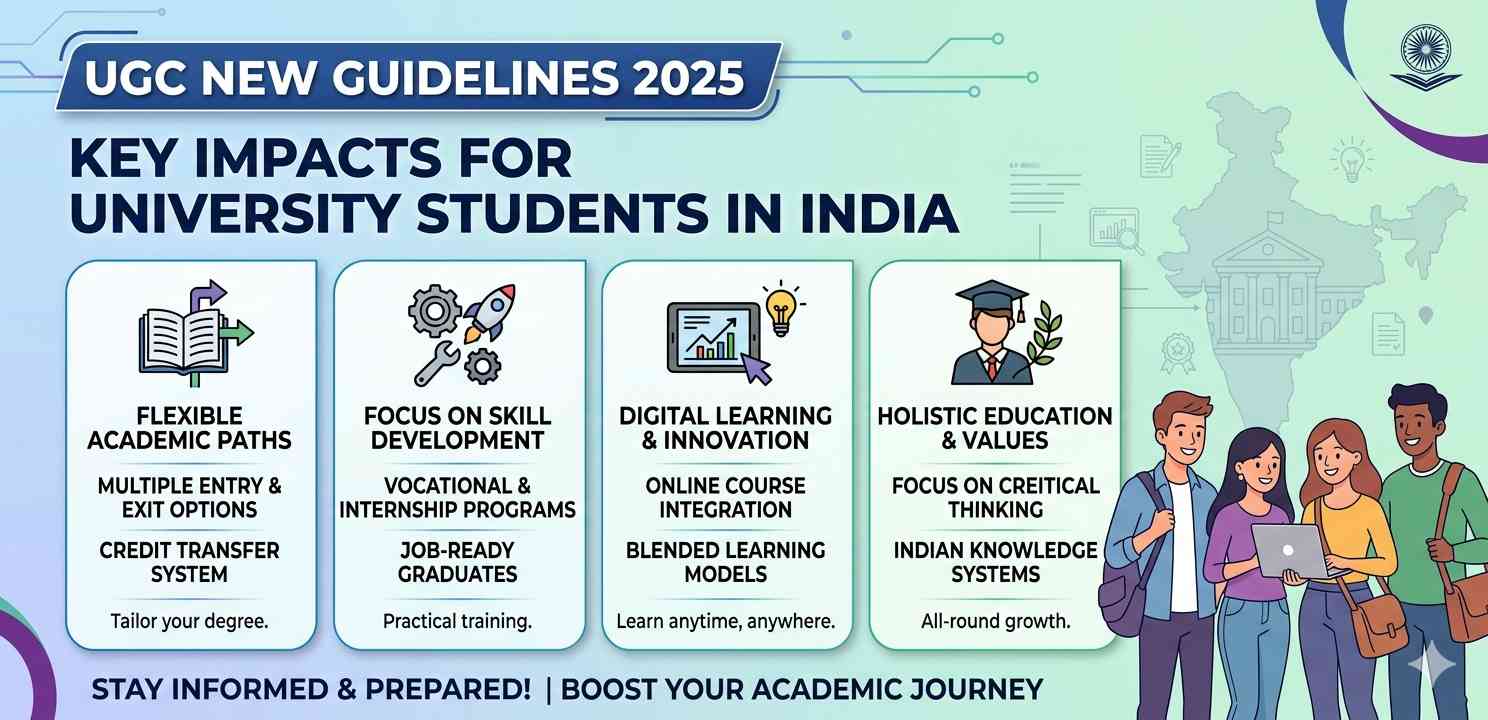
Introduction
If you are a university student in India — or planning to become one — you have probably heard something about the UGC new guidelines 2025. Maybe your college notice board has a new circular. Maybe your seniors are confused about credit systems or semester rules. Whatever you have heard, the truth is that these changes are real, they are significant, and they affect almost every student enrolled in a higher education institution in the country.
The University Grants Commission, commonly known as UGC, is the central body that regulates universities and colleges across India. When it releases new rules, institutions have to follow them. And in 2025, UGC has rolled out a fresh set of guidelines that touch nearly every corner of student life — from how you earn credits to how you appear in exams.
This article breaks down the UGC new guidelines 2025 in plain language, explains what is changing, and tells you honestly what it means for your studies.
What Is UGC and Why Do Its Guidelines Matter?
Before getting into the specifics, it helps to understand what UGC actually does. The University Grants Commission was established under an Act of Parliament in 1956. It maintains standards for higher education, distributes funds to universities, and sets rules that colleges must follow to stay recognized.
So when UGC updates its policies, it is not optional advice. Universities that want to keep their accreditation and funding must align their systems accordingly. That is why the UGC new guidelines 2025 carry real weight — they change how institutions operate, and by extension, how students move through their degrees.
Major Changes Introduced Under the UGC New Guidelines 2025
1. Academic Bank of Credits (ABC) Now Mandatory
One of the biggest shifts in the UGC new guidelines 2025 is the push to make the Academic Bank of Credits (ABC) compulsory for students across central and state universities.
The ABC system works like a digital savings account for your academic credits. Every time you complete a course — whether at your home college or through an online platform like SWAYAM — the credits go into your account. You can use these stored credits later if you switch universities, take a break from studies, or want to pursue a different programme.
This is genuinely useful. Earlier, if a student transferred from one university to another, they often had to repeat courses. With the ABC framework, that problem becomes much smaller.
2. Flexibility in Entry and Exit Points
The UGC new guidelines 2025 continue and strengthen the multiple entry and exit system that was introduced under the National Education Policy (NEP) 2020. Students can now leave a degree programme after one year and get a certificate, after two years and get a diploma, or complete the full degree.
More importantly, they can re-enter the programme within a specified period and pick up from where they left, without losing their earlier academic work. This is especially meaningful for students from low-income backgrounds who sometimes have to pause their education for financial or family reasons.
3. Changes in Examination and Evaluation Systems
The UGC new guidelines 2025 include revised guidelines on continuous assessment. Universities are now expected to reduce dependence on a single year-end examination. The idea is to spread evaluation across the semester through assignments, internals, and project work.
This is a welcome move for many students who feel that one exam should not determine everything. However, it does place a higher burden of regular preparation throughout the semester. You cannot leave everything for the last month anymore — or at least, you should not.
4. Online and Blended Learning Integration
Another major element of the UGC new guidelines 2025 is the recognition and regulation of online learning within regular degree programmes. Institutions can now allow up to 40 percent of their total course credits to come from online modes, including SWAYAM and other UGC-approved platforms.
For students in Tier 2 and Tier 3 cities where physical resources and faculty are sometimes limited, this opens up access to quality content. It also means that students who want to pace their own learning have more flexibility than before.
How UGC New Guidelines 2025 Affect Admissions
Admission processes are also undergoing reform under the UGC new guidelines 2025. The Common University Entrance Test (CUET) remains the central mechanism for undergraduate admissions to central universities. But the new rules extend its applicability and also suggest states consider a similar standardised approach.
One significant addition is the provision for holistic admissions — meaning universities are encouraged to consider factors beyond just test scores, such as co-curricular achievements and special category considerations. This is still being implemented differently across institutions, so students should check with their specific university for exact procedures.
Impact on Postgraduate Students
Graduate students are not left out of the UGC new guidelines 2025. The guidelines introduce clearer frameworks for research-based and coursework-based postgraduate degrees. There is now a push for more structured internship and fieldwork components in PG programmes, especially in professional and applied disciplines.
PhD admissions have also been streamlined. While the National Eligibility Test (NET) remains the primary qualifier for many PhD and fellowship positions, universities now have more structured internal screening options for certain categories of applicants. Read more about NET eligibility and research fellowship criteria on the UGC official website.
What These Guidelines Mean for Students in Private Universities
Private universities are required to comply with UGC new guidelines 2025 as a condition of their recognition. This means even autonomous private institutions need to align their credit systems, evaluation norms, and online learning frameworks with what UGC prescribes.
In practice, compliance varies. Some well-resourced private universities have already made changes. Others are still catching up. If you are in a private institution, it is worth checking whether your university has updated its academic calendar and credit structure accordingly. If they have not, you have every right to ask — and UGC’s grievance portal (ugcgrievance.in) exists precisely for such situations.
The Credit System Explained Simply
A lot of confusion around the UGC new guidelines 2025 comes from the credit system. Here is a simple way to think about it.
One credit typically equals one hour of lecture per week per semester. A standard three-year undergraduate degree usually requires around 120–130 credits in total. Under the new framework, students can earn credits not just through classroom learning but also through skill courses, community engagement, internships, and even certain competitive examinations.
This is part of making Indian degrees more comparable to global standards — a step that matters if you plan to pursue higher education or jobs abroad.
Practical Steps Students Should Take Right Now
Given all the changes under the UGC new guidelines 2025, here is what you should actually do:
Register for the Academic Bank of Credits. If your university has not done this automatically, visit the DigiLocker-linked ABC portal and create your account. Your academic ID links to it.
Check your institution’s updated credit structure. Ask your department head or academic office for the revised programme structure that aligns with these guidelines. Do not assume the old structure still applies.
Explore SWAYAM courses. If your college allows credits from online courses, pick courses that genuinely interest you or fill skill gaps. The UGC has a list of approved courses on SWAYAM.
Keep copies of all your academic records. As the credit transfer system becomes more active, maintaining proper records of completed courses and grades will help you enormously.
Criticism and Concerns Around UGC New Guidelines 2025
Not everyone is happy with how these changes are being rolled out. Some faculty members and student unions have pointed out that universities — especially state government universities with limited infrastructure — are not fully prepared to implement the UGC new guidelines 2025 smoothly.
There are concerns about uneven implementation. A well-funded central university in a metro city and a state college in a rural district are not equally positioned to deliver blended learning or digitise their credit systems overnight. Students in underfunded institutions could end up with paper compliance rather than real change.
These are valid concerns, and they are being raised in academic and policy circles. It does not mean the guidelines are bad in principle — but it does mean students need to stay alert and informed about how their specific institution is responding.
Final Conclusion
The UGC new guidelines 2025 represent one of the most wide-reaching reforms to Indian higher education in recent years. From flexible degree structures and credit banking to revised examination norms and online learning integration, these changes have the potential to genuinely modernise how students experience university education in India.
But change on paper and change in practice are two different things. Students who stay informed, ask the right questions, and use the tools and resources now available to them will be best placed to benefit. If you are currently enrolled in a degree programme — or about to join one — understanding these guidelines is not just helpful. It is essential.