 admin@graminguru.in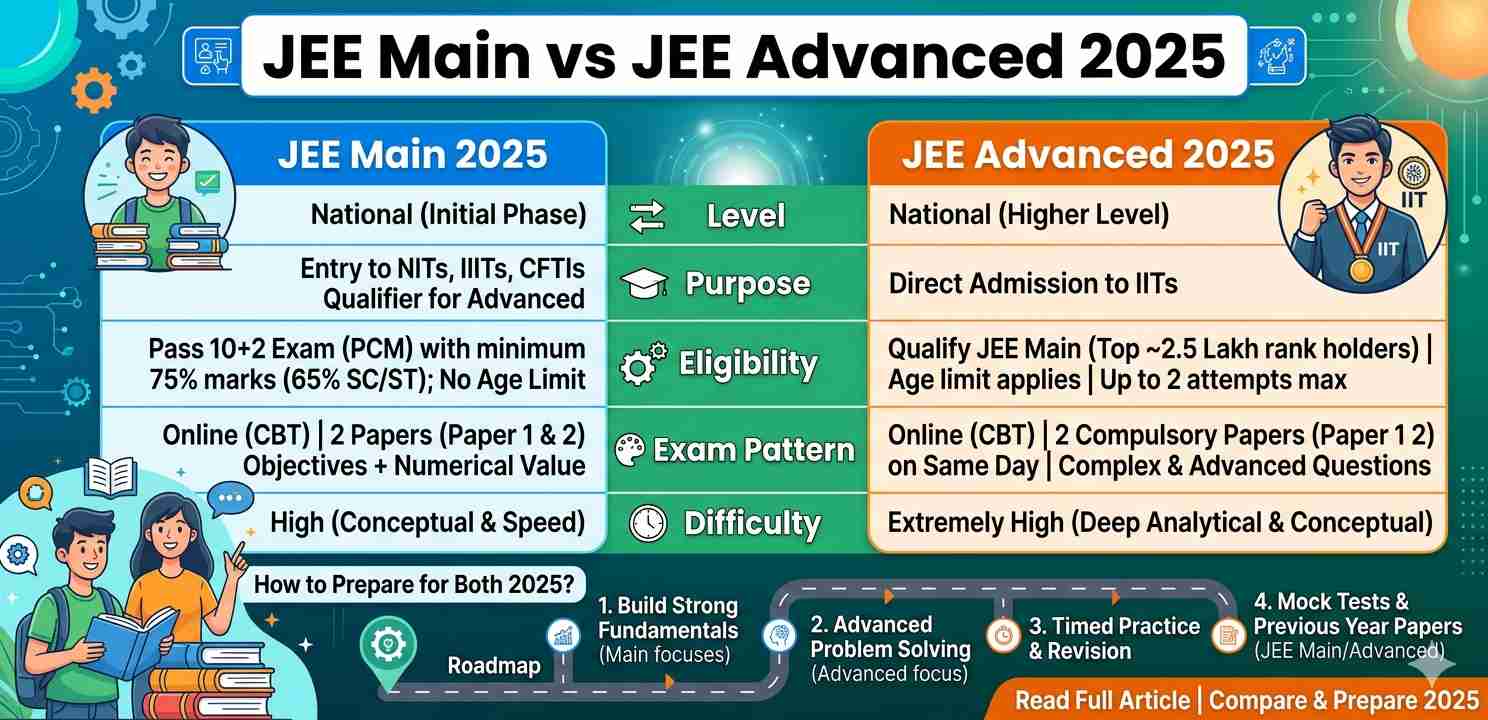
Introduction
Every year, lakhs of students across India prepare for engineering entrance exams with one dream — getting into a top engineering college. And at the centre of that dream are two exams: JEE Main vs JEE Advanced. These two exams are often talked about together, but they are very different from each other in terms of purpose, difficulty, and what they lead to.
If you are a Class 11 or 12 student, or someone who is planning to appear for engineering entrance exams in 2025, this article will help you understand exactly what each exam is, who can appear, and how to prepare smartly. Let’s start from the basics and go deeper as we move along.
What Is JEE Main 2025?
JEE Main, short for Joint Entrance Examination (Main), is a national-level entrance exam conducted by the National Testing Agency (NTA). It is held twice a year — once in January and once in April. Millions of students appear for this exam each year, making it one of the largest engineering entrance exams in the world.
JEE Main is the gateway to admission in NITs (National Institutes of Technology), IIITs, and other centrally funded technical institutions across India. It also acts as the qualifying exam for JEE Advanced.
When you compare JEE Main vs JEE Advanced, the first clear difference is their purpose. JEE Main is for a wider range of colleges, while JEE Advanced is specifically for IITs.
What Is JEE Advanced 2025?
JEE Advanced is the second stage of the IIT entrance process. Only the top 2.5 lakh candidates who clear JEE Main are eligible to appear for JEE Advanced. It is conducted by one of the IITs on a rotational basis.
Clearing JEE Advanced is the only way to secure admission in the prestigious Indian Institutes of Technology (IITs). The exam is known for its high difficulty level, deep conceptual questions, and multi-step problems that test real understanding — not just memorization.
So in the debate of JEE Main vs JEE Advanced, the stakes are very different. One opens doors to several good colleges; the other opens the door to IITs.
JEE Main vs JEE Advanced: Key Differences at a Glance
Understanding the differences between these two exams can save you a lot of confusion during your preparation. Here’s a breakdown:
Conducting Body
JEE Main is conducted by NTA (National Testing Agency). JEE Advanced, on the other hand, is organized by one of the IITs — in 2024, it was IIT Madras. Each year, a different IIT takes on this responsibility.
Exam Frequency
JEE Main is held twice a year, giving students two chances to improve their score. JEE Advanced is held only once a year, so there is no second chance within the same academic cycle.
Number of Attempts
For JEE Main, a student can attempt the exam a maximum of 3 consecutive years. For JEE Advanced, the limit is 2 attempts — and only in consecutive years. This is a critical difference when you are planning your preparation timeline in the context of JEE Main vs JEE Advanced.
Exam Pattern
JEE Main has three papers:
- Paper 1 for B.Tech/B.E. (Physics, Chemistry, Mathematics)
- Paper 2A for B.Arch
- Paper 2B for B.Planning
JEE Advanced has two papers (Paper 1 and Paper 2), both of which are mandatory to appear in on the same day. The question types in Advanced are more varied — including single correct, multiple correct, integer-type, and paragraph-based questions.
Marking Scheme
JEE Main follows a relatively straightforward marking scheme with negative marking for wrong answers in multiple-choice questions. JEE Advanced has a more complex marking scheme — some sections have partial marking, while others have full negative marking. This complexity is one of the reasons why JEE Main vs JEE Advanced difficulty is so talked about.
Eligibility Criteria: JEE Main vs JEE Advanced 2025
Eligibility for JEE Main 2025
- The student must have passed Class 12 (or equivalent) with Physics, Chemistry, and Mathematics.
- Students appearing in Class 12 exams in 2025 are also eligible.
- There is no minimum percentage requirement from NTA for JEE Main itself, but individual colleges may have their own cut-offs.
- Age limit: Candidates born on or after October 1, 2000 are generally eligible (for general category).
Eligibility for JEE Advanced 2025
This is where it gets stricter:
- The candidate must be among the top 2.5 lakh qualifiers of JEE Main 2025.
- The candidate must have appeared in Class 12 (or equivalent) for the first time in 2024 or 2025.
- A candidate can attempt JEE Advanced a maximum of 2 times in consecutive years.
- There is a minimum percentage requirement in Class 12 — typically 75% for general category (65% for SC/ST/PwD).
- Candidates who were previously admitted to an IIT are NOT eligible.
Knowing these eligibility rules is very important when comparing JEE Main vs JEE Advanced, because assuming you’ll automatically be eligible for Advanced after clearing Main is a common mistake.
Difficulty Level: Which One Is Harder?
This is probably the most common question students ask when discussing JEE Main vs JEE Advanced. The short answer is — JEE Advanced is significantly harder.
JEE Main tests your knowledge of the NCERT syllabus at a moderate to high difficulty level. The questions are mostly direct and formula-based, though some require multi-step thinking.
JEE Advanced goes much deeper. The questions require you to connect multiple concepts, apply them in unusual scenarios, and think under pressure. You won’t find questions directly from the textbook here. The exam is designed to separate the top 1–2% of students from the rest.
If you score around 120–150 in JEE Main, you might get a decent NIT. But to get into a top IIT, you typically need to be in the top 500–2000 rank in JEE Advanced — and that requires a completely different level of preparation.
Syllabus Comparison: JEE Main vs JEE Advanced
JEE Main Syllabus
The syllabus is based entirely on NCERT Class 11 and 12 textbooks. It covers:
- Physics: Mechanics, Thermodynamics, Optics, Modern Physics, Electricity & Magnetism
- Chemistry: Physical, Organic, Inorganic Chemistry
- Mathematics: Algebra, Calculus, Trigonometry, Coordinate Geometry, Vectors
JEE Advanced Syllabus
The syllabus is similar in topics but goes deeper. Some topics not covered in NCERT — like certain advanced integration techniques, or complex number applications — can appear. The level of application expected is much higher.
One key thing students miss when studying JEE Main vs JEE Advanced syllabus: Advanced doesn’t have a fixed chapter list published by NTA. You need to go through the official syllabus released by the organizing IIT each year.
How to Prepare for JEE Main 2025
Here are some practical, experience-based tips:
Start with NCERT. This is not just advice — it is the foundation. Class 11 and 12 NCERT books for Physics, Chemistry, and Math are your base. Read them carefully and understand every concept.
Practice previous year papers. The last 10 years of JEE Main papers are freely available online. Solving them regularly gives you a feel for the exam pattern, common topics, and time management.
Focus on weak subjects early. Most students avoid their weakest subject until the last moment. That is a mistake. Give extra time to the subject where you lose the most marks.
Mock tests are non-negotiable. Join a test series or use free platforms like NTA’s official mock test portal to simulate exam conditions regularly.
Revision strategy matters. Make short notes of formulas, exceptions, and important reactions. Revise them every weekend. What you revise three times stays longer than what you study once for three hours.
How to Prepare for JEE Advanced 2025
Preparing for JEE Advanced requires a different mindset than JEE Main. Here’s what actually works:
Master conceptual clarity. You cannot afford to memorize formulas without understanding them. JEE Advanced is specifically designed to expose gaps in understanding.
Study from standard reference books. For Physics — H.C. Verma and I.E. Irodov (selected problems). For Chemistry — O.P. Tandon and J.D. Lee. For Maths — S.L. Loney and Hall & Knight for selected topics. These books are highly recommended by IIT toppers and coaching faculties alike.
Solve JEE Advanced past papers. Papers from the last 10–15 years are the best resource. You will notice recurring themes and question styles that help you prepare strategically. You can access them through IIT JEE official archives.
Don’t ignore Paper 2. Many students focus heavily on one paper and underperform in the other. Both papers carry equal weight and you must attempt both.
Time management during the exam. JEE Advanced paper timing is strict. Practice completing full mock papers within the time limit. Learn to identify and skip questions you can’t solve in the first pass.
Common Mistakes to Avoid
Whether you are preparing for JEE Main, JEE Advanced, or both, these mistakes cost students dearly every year:
- Skipping NCERT thinking it’s too basic — don’t do this. NCERT is especially important for Chemistry.
- Not attempting JEE Main seriously thinking it’s “just a qualifying exam” for Advanced — your JEE Main rank also determines your NIT/IIIT admission.
- Over-relying on coaching material without building independent problem-solving skills.
- Ignoring mental health and sleep during the preparation phase — burnout before the exam is real.
Final Conclusion
To sum it up simply: JEE Main vs JEE Advanced is not a competition — they are two stages of one journey. JEE Main opens doors to hundreds of top engineering colleges across the country. JEE Advanced opens the door to IITs, which are among the best technical institutions in Asia.
Start by building a solid foundation for JEE Main. Once you qualify, shift your focus to the deeper, more challenging preparation that JEE Advanced demands. Both exams reward students who are consistent, clear in their concepts, and disciplined in their practice.
There is no shortcut, but there is a smart path. Build it step by step, and 2025 can be your year.