 admin@graminguru.in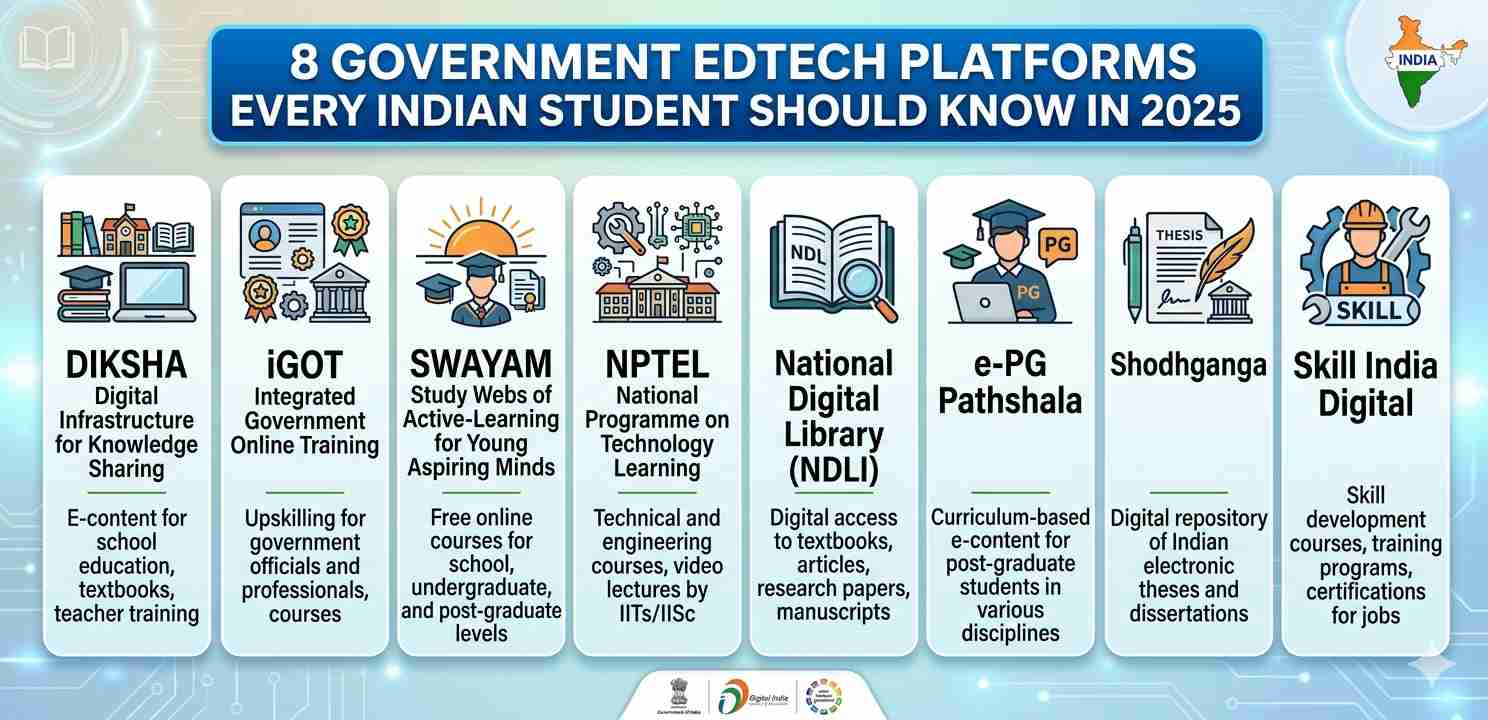
Introduction
If you’re a student in India and you haven’t heard of most of these tools, you’re honestly leaving a lot on the table. The Indian government has quietly built a fairly solid lineup of government EdTech platforms over the last several years — and in 2025, many of these are more useful than ever.
Some of these platforms offer free textbooks. Some let you earn certificates. Others are built specifically for skill development or job preparation. The best part? You don’t need to pay anything to get started with most of them.
This article walks you through 8 government EdTech platforms that every Indian student — school-going or college-level — should seriously know about. Let’s go through them one by one.
1. DIKSHA — Digital Infrastructure for Knowledge Sharing
DIKSHA is probably the most widely used of all government EdTech platforms in India right now. It was launched by the Ministry of Education and is designed primarily for school students from Class 1 to Class 12.
The platform hosts textbook-linked digital content, video lessons, quizzes, and worksheets — all tied to your actual NCERT or State Board curriculum. So if you’re studying Chapter 5 of your Class 9 Science textbook, you can find related videos and activities right there on DIKSHA.
Teachers also use it heavily. If you’re a student and your school uses QR codes on textbooks, those codes usually link back to DIKSHA content.
How to access: Visit diksha.gov.in or download the DIKSHA app on Android. It’s available in multiple Indian languages, which makes it accessible for students across different states.
2. SWAYAM — Free Online Courses from Indian Universities
SWAYAM stands for Study Webs of Active Learning for Young Aspiring Minds. It’s one of those government EdTech platforms that genuinely rivals paid alternatives, at least for college students.
The platform hosts hundreds of online courses taught by professors from IITs, IIMs, NITs, and other reputed central universities. You can study subjects like Data Science, Economics, Literature, Engineering, Management — the list goes on.
What makes it more useful than just watching YouTube lectures is that SWAYAM offers proctored exams. If you pass them, you can earn credit that some universities officially recognize on your transcript.
So if you’re a graduation student looking to strengthen your knowledge in a particular subject, SWAYAM is one of the most practical government EdTech platforms available to you today.
How to access: Head over to swayam.gov.in and register with your email. Enrollment is free.
3. SWAYAM PRABHA — Free Educational TV Channels
Not everyone has reliable internet at home. SWAYAM PRABHA addresses exactly that. It’s a group of 34 DTH (Direct To Home) television channels that broadcast educational content round the clock.
This is one of the more underrated government EdTech platforms because it works without internet at all. You just need a DTH connection at home — which many rural households already have.
The channels cover school-level subjects, higher education topics, teacher training content, and vocational courses. Recordings of the broadcasts are also available on the SWAYAM PRABHA website for students who want to watch them later online.
If you live somewhere with patchy internet, this channel-based approach is actually quite thoughtful.
4. National Digital Library of India (NDLI)
The National Digital Library of India, or NDLI, is exactly what it sounds like — a massive digital library with millions of learning resources. It’s one of those government EdTech platforms that students often overlook until they desperately need a research paper or an old textbook.
NDLI gives you access to books, thesis papers, journal articles, audiobooks, and educational videos — all in one place. It’s developed by IIT Kharagpur and supported by the Ministry of Education.
As a student, you can find rare textbooks, competitive exam preparation material, and research content without paying subscription fees. The collection covers content for school students all the way up to PhD scholars.
How to access: Go to ndl.iitkgp.ac.in and create a free account.
5. ePathshala — NCERT Digital Textbooks and Resources
If you’ve ever searched for your NCERT textbook online and ended up on a sketchy PDF site, ePathshala is the answer to that problem. It’s the official NCERT platform that hosts all textbooks in digital form — for free, legally, and cleanly.
Among government EdTech platforms, ePathshala is the go-to for school students who want their exact NCERT books in Hindi, English, or Urdu without any fuss.
Beyond textbooks, it also offers audio books, flip books, and video content mapped to the NCERT syllabus. The mobile app works well even on older Android phones, which is helpful for students who don’t have access to a laptop or desktop.
This platform is especially useful during exam time when students want to quickly revise chapters or look up specific content without hunting for physical books.
6. iGOT Karmayogi — Capacity Building for Learners and Professionals
iGOT Karmayogi is slightly different from the other entries here. It was originally built as a capacity building platform for government employees, but it’s increasingly being opened up for broader learners including college students and young professionals.
The platform offers curated courses on leadership, governance, technology, communication, and civic skills. If you’re preparing for UPSC, SSC, or any government service exam, some of the content on iGOT is genuinely relevant.
Among government EdTech platforms, iGOT is probably the most “professional development” focused. Think of it less like a school platform and more like a structured learning environment for people who want to understand how public systems work.
How to access: Visit igotkarmayogi.gov.in to explore current offerings.
7. NIOS Open School — Flexible Schooling for Out-of-System Students
The National Institute of Open Schooling (NIOS) is one of the largest open schooling boards in the world. It’s not just an EdTech platform in the traditional sense — it’s an entire alternative pathway to completing your school education.
If you couldn’t finish school for any reason, NIOS lets you complete your Class 10 or Class 12 on your own schedule. As a government EdTech platform with official recognition, certificates from NIOS are accepted by colleges and universities across India.
The online portal offers study material, recorded video lessons, and online exam registration. For students who’ve dropped out or taken a gap, NIOS is often the most practical route back into the formal education system.
It’s also useful for students who want to add a vocational subject to their qualifications without full-time enrollment.
8. Skill India Digital Hub — Vocational and Job-Ready Learning
The Skill India Digital Hub is the digital arm of the National Skill Development Corporation (NSDC). It’s one of the more recent additions among government EdTech platforms, and it’s focused entirely on skill-based and vocational learning.
Here you can find short-term certificate courses in areas like digital marketing, IT support, retail, healthcare assistance, financial services, and more. Many of the courses are tied to industry certifications and actual job placement support.
For students who want to enter the workforce quickly — or want a practical skill alongside their regular studies — this is a very solid option. The government has been partnering with private companies to keep the course content relevant and industry-aligned.
How to access: Explore the platform at skillindia.gov.in.
How to Choose the Right Platform for Your Needs
With so many government EdTech platforms available, it’s easy to feel overwhelmed. Here’s a simple way to think about it:
- School student (Class 1–12): Start with DIKSHA and ePathshala. Both are directly tied to your curriculum.
- College student: SWAYAM is your best bet. NDLI helps with research.
- Vocational learner or job seeker: Skill India Digital Hub is the right place.
- No internet at home: SWAYAM PRABHA works on your DTH connection.
- Dropped out of school: NIOS can help you get back on track officially.
- Preparing for government jobs: iGOT Karmayogi has relevant governance content.
Mixing two or three of these government EdTech platforms based on your current situation usually works better than trying to use all of them at once.
Are These Platforms Actually Useful? Honest Take
There’s a fair criticism that many government platforms look good on paper but are clunky to use. And honestly, some of these do have their rough edges — slow loading, outdated interfaces, or occasional navigation issues.
But most of them have improved noticeably over the past couple of years. DIKSHA, especially, has become much more polished. SWAYAM’s course quality is genuinely solid for free content. And NDLI’s search has gotten better.
The key is to approach them like tools, not experiences. You’re not there for a sleek app — you’re there for legitimate, curriculum-aligned, free learning. On that front, these government EdTech platforms deliver more than most people give them credit for.
Final Conclusion
India’s investment in government EdTech platforms has created a surprisingly broad ecosystem of free learning resources. From DIKSHA’s school-level content to SWAYAM’s university-grade courses, from NIOS’s flexible schooling options to the Skill India Digital Hub’s job-ready training — there’s genuinely something useful here for every kind of student.
The platforms aren’t perfect. But they’re official, they’re free, and they’re improving. In 2025, any student who ignores these resources is essentially walking past a library without going in.