
 admin@graminguru.in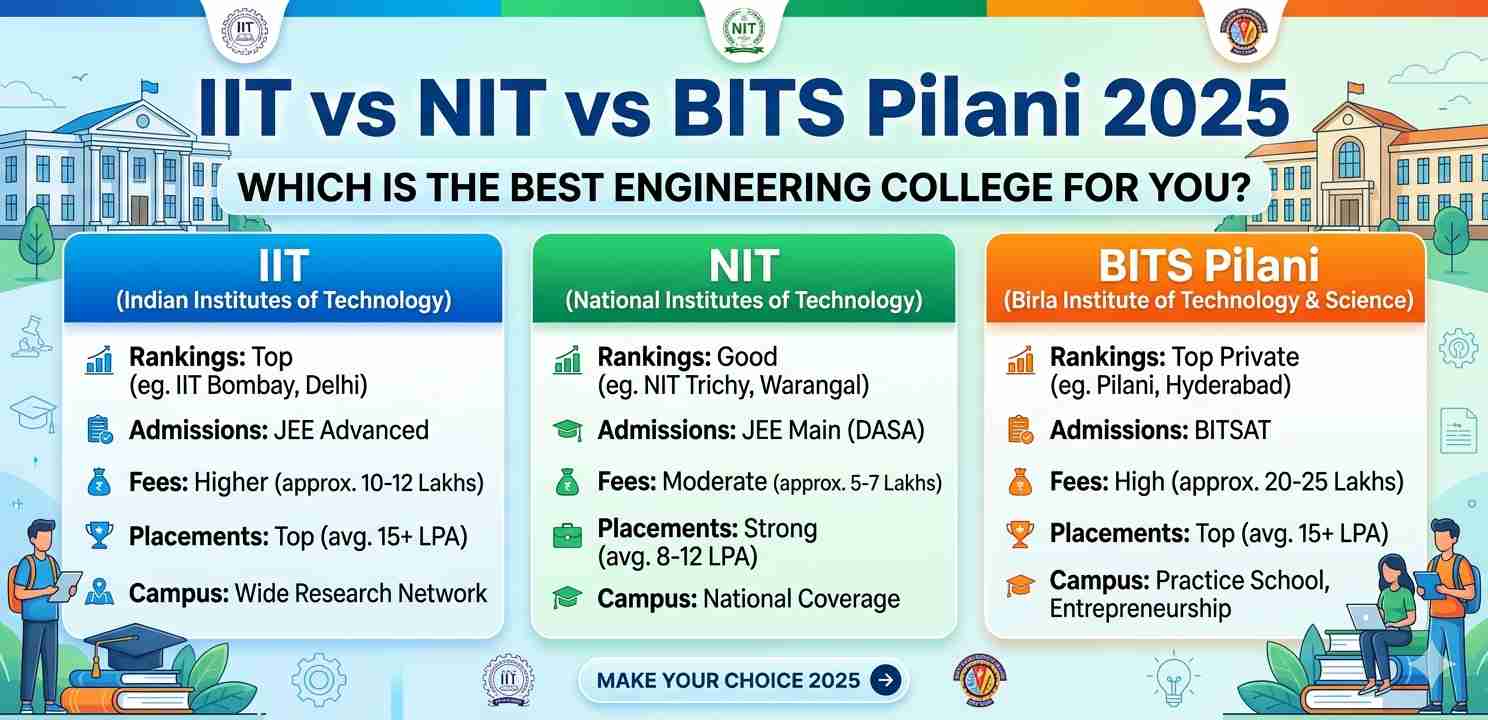
Introduction
Every year, lakhs of students across India sit down with their JEE results and start asking the same question — IIT vs NIT vs BITS Pilani, which one should I go for? It sounds simple, but trust me, the answer is rarely straightforward.
The truth is, all three are excellent institutions. But “excellent” means different things for different students. Someone chasing research might not belong in the same college as someone eyeing a startup career or a core engineering job. This guide tries to cut through the noise and give you a clear, honest picture of each option.
I’ve spoken to students from all three types of institutions, looked at actual placement data, and considered everything from fees to flexibility. So let’s get into it — no fluff, just real information.
What Are IITs, NITs, and BITS Pilani — A Quick Overview
Before comparing, it helps to understand what each of these institutions actually is.
IITs (Indian Institutes of Technology) are autonomous public universities funded directly by the central government. There are currently 23 IITs across India. They’re considered the gold standard of engineering education in the country.
NITs (National Institutes of Technology) are also centrally funded, and there are 31 of them. While they don’t carry the same brand weight as IITs, several top NITs — like NIT Trichy, NIT Surathkal, and NIT Warangal — are genuinely world-class institutions.
BITS Pilani is a private deemed university with four campuses: Pilani, Goa, Hyderabad, and Dubai. Unlike IITs and NITs, it doesn’t require JEE. It has its own entrance exam called BITSAT. BITS is well-known for its flexible curriculum and strong industry connections.
IIT vs NIT vs BITS Pilani: Admission Process Compared
This is often the first filter for most students, and it’s an important one.
Getting Into an IIT
To get into an IIT, you need to clear JEE Advanced — which means you first have to qualify JEE Mains with a good rank and then appear for JEE Advanced. The competition is brutal. Out of over a million students who sit for JEE Mains, only around 2.5 lakh are eligible for Advanced, and IITs admit roughly 16,000–17,000 students per year.
The cutoffs for top IITs like IIT Bombay, IIT Delhi, and IIT Madras are extremely high. Even for less popular branches, you’re looking at AIR below 5,000 for a decent shot.
Getting Into an NIT
NITs also use JEE Mains scores, but through the JoSAA (Joint Seat Allocation Authority) counselling process. There’s no JEE Advanced requirement. This opens the door for a much larger number of students.
Top NITs like NIT Trichy and NIT Warangal are competitive, but you don’t need a top 1% rank to get in. A JEE Mains rank in the range of 5,000–25,000 (general category) can get you into a decent NIT and branch.
Getting Into BITS Pilani
BITS Pilani doesn’t accept JEE scores at all — a fact that surprises many students. You need to appear for BITSAT, conducted by BITS itself. The exam is computer-based and tests Physics, Chemistry, Maths, English, and Logical Reasoning.
BITS also considers Class 12 board marks. You need at least 75% aggregate with Physics, Chemistry, and Maths. For some campuses and branches, it goes higher.
The advantage here is that if your JEE preparation hasn’t gone as planned but your BITSAT score is strong, BITS remains a legitimate and prestigious path.
IIT vs NIT vs BITS Pilani: Fees and Financial Accessibility
This is a factor that often doesn’t get enough attention in comparisons.
IIT Fees
IITs are heavily subsidised. The fee for a B.Tech program is roughly ₹2–2.5 lakh per year for general category students. For EWS/SC/ST students, it can be even less, and many students receive fee waivers.
When you consider the quality of infrastructure and faculty, the fee-to-value ratio at IITs is honestly hard to beat. Scholarships and GATE fellowships for higher studies also ease the financial burden significantly.
NIT Fees
NIT fees are slightly higher than IITs on average — around ₹1.25–1.75 lakh per semester (so roughly ₹2.5–3.5 lakh per year). Some NITs charge more depending on the course and category.
They’re still very affordable compared to most private engineering colleges in India, and they come with the advantage of government-backed quality assurance.
BITS Pilani Fees
BITS is where the cost jumps noticeably. Annual fees at BITS Pilani (Pilani campus) are around ₹5–6 lakh per year, and at Goa and Hyderabad campuses, it can be similar or slightly lower. Over four years, that’s ₹20–24 lakh in tuition alone, not counting hostel and food.
BITS does offer some scholarships, but they’re limited. Most students rely on education loans. If cost is a major concern, BITS requires serious financial planning.
Placements: Where Do Graduates Actually End Up?
The placement question is what most students and parents care about the most. Let’s be honest about the numbers.
IIT Placements in 2024–25
IITs, especially the older ones (IIT Bombay, Delhi, Madras, Kanpur, Kharagpur), have some of the best placement records in the country. Average packages at top IITs range from ₹20–25 LPA, with median packages around ₹15–18 LPA for popular branches like CS and Electronics.
International offers from companies like Google, Microsoft, Goldman Sachs, and Jane Street are also common. Not everyone gets a ₹1 crore package, but the sheer diversity and quality of recruiters visiting IIT campuses is genuinely impressive.
NIT Placements in 2024–25
Top NITs have strong placements, but there’s a wider variation. NIT Trichy, Warangal, and Surathkal consistently produce graduates who land at top-tier companies. Average packages at these NITs sit around ₹10–18 LPA, which is solid.
However, newer or lower-ranked NITs may have average packages around ₹5–8 LPA, and placement consistency isn’t always reliable. Branch choice matters a lot at NITs.
BITS Pilani Placements in 2024–25
BITS Pilani has a strong placement culture. The Pilani campus typically sees average packages around ₹15–20 LPA, with top offers going well above ₹30 LPA. The Goa and Hyderabad campuses are slightly lower but still competitive.
One unique advantage of BITS is its Practice School (PS) program — a structured internship component where students spend time working at actual companies. This gives BITS graduates a practical edge that many employers genuinely value.
Academic Flexibility and Curriculum
This is an area where each institution has its own philosophy.
IIT — Deep Research Culture
IITs are built around research and academic depth. The curriculum can be intense, and there’s a strong push toward graduate studies, PhDs, and academic careers. If you’re someone who loves exploring theory and wants to go deep into a subject, IITs are ideal.
The professor quality at top IITs is exceptional — many have PhDs from MIT, Stanford, or IISc and have published globally.
NIT — Practical and Industry-Oriented
NITs strike a balance. The curriculum is structured and industry-aligned. Most NIT graduates go directly into core engineering jobs, IT companies, or PSUs (Public Sector Undertakings). If you want a stable engineering career without necessarily going into research, a good NIT is a very practical choice.
The academic environment is competitive but not as high-pressure as IITs, which some students find more sustainable.
BITS Pilani — Flexibility Is the Highlight
BITS is known for something unique — its flexible course structure. Students can take up a dual degree combining engineering with management, science, or finance. There’s no compulsory attendance (this varies by campus). Students can design a significant part of their academic journey.
For entrepreneurial students or those who want to explore multiple fields, BITS offers freedom that IITs and NITs don’t always match.
Campus Life, Location, and Overall Environment
Life outside the classroom matters more than most people admit during admissions season.
IIT campuses tend to be large, well-maintained, and full of clubs, cultural fests, and technical events like Techfest (IIT Bombay) and Shaastra (IIT Madras). The pressure is real, but so is the peer quality.
BITS Pilani’s main campus is in a small town, which forces students to build a self-contained community. It’s tight-knit, creative, and known for one of India’s biggest college cultural festivals — OASIS. The Goa campus has a more relaxed vibe.
NIT campuses vary a lot. NITs like Trichy and Warangal have excellent infrastructure. Smaller NITs may feel more local, but they come with a community feel that many students appreciate.
So, IIT vs NIT vs BITS Pilani — Which Should You Pick?
Here’s an honest breakdown:
Choose IIT if: You cleared JEE Advanced with a decent rank, want world-class research exposure, and value the brand for higher studies abroad or in core research fields.
Choose NIT if: Your JEE Mains rank is competitive, you want affordable quality education, and your goal is a stable engineering career or civil services preparation.
Choose BITS Pilani if: Your BITSAT score is strong, you can manage the fees, and you want academic flexibility, strong internships through PS, and a vibrant campus culture.
The honest truth about IIT vs NIT vs BITS Pilani is that your success depends far more on what you do once you’re inside than on which gate you entered through.
Final Conclusion
The debate around IIT vs NIT vs BITS Pilani has no single correct answer, and anyone who tells you otherwise is oversimplifying things. All three are legitimate pathways to a strong engineering career. Your choice should be based on your entrance exam performance, financial situation, career goals, and the kind of environment where you personally thrive.
If affordability matters, IITs and NITs are harder to beat. If flexibility and internships are your priority, BITS Pilani deserves serious consideration. And if you’ve cracked JEE Advanced with a good rank, don’t overthink it — the IIT experience is genuinely worth it.
For more guidance on making the right college choice, you may find the JoSAA official counselling portal and the BITS Pilani admissions page helpful as primary references.