
 admin@graminguru.in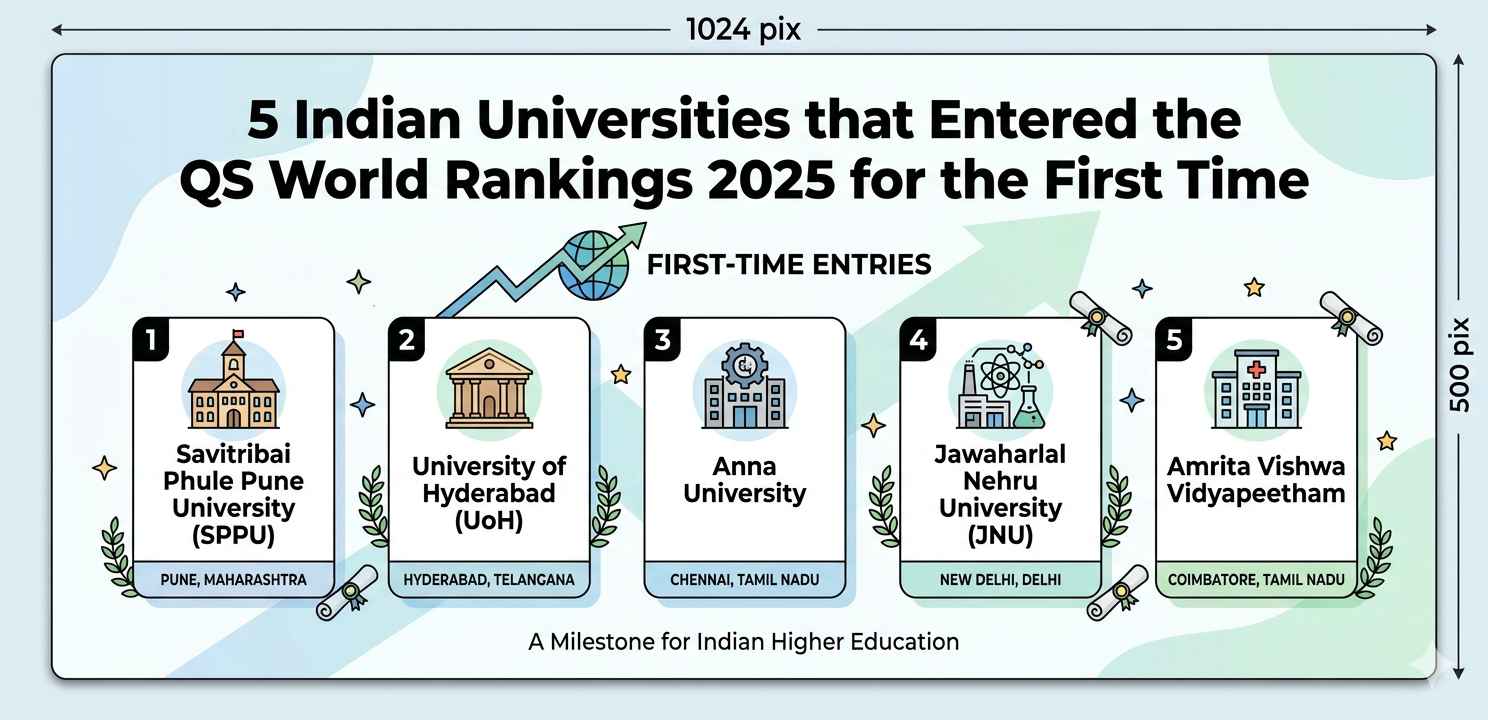
Introduction
Every year, thousands of students across India search for the best colleges to attend. Most of them look at national rankings — NIRF, NAAC grades, and so on. But a growing number of students and parents are now paying attention to something bigger: global rankings. And in 2025, the story of Indian universities in QS World Rankings 2025 became a topic of real pride.
For the first time, 46 Indian universities were listed in the QS World University Rankings 2025, released in June 2024. Among them, several institutions made their debut on this prestigious global list. That’s not a small thing. Getting into the QS ranking means your university is being compared to institutions from over 100 countries. It signals academic quality, research output, employer reputation, and global relevance.
This article covers 5 Indian universities that entered the QS World Rankings 2025 for the very first time — what they are, why they qualified, and what this means for students like you.
What Are the QS World University Rankings?
Before jumping into the list, it helps to understand what QS actually measures. QS stands for Quacquarelli Symonds, a UK-based company that evaluates universities every year on a set of specific parameters.
The main factors they look at include:
- Academic Reputation – How highly do professors and researchers around the world rate the university?
- Employer Reputation – Do major companies prefer to hire graduates from that institution?
- Citations per Faculty – How much is the university’s research being cited by other researchers globally?
- Faculty-to-Student Ratio – How many teachers are available per student?
- International Faculty and Students – Does the university attract people from other countries?
- Sustainability and Employment Outcomes – New metrics added in 2025 to reflect modern priorities.
Getting into this list is genuinely hard. A university must score well across multiple indicators, and the QS team collects data from millions of academic surveys and employer surveys worldwide. So when an Indian university enters the QS World Rankings 2025 for the first time, it’s a real milestone.
Why 2025 Was a Landmark Year for Indian Higher Education
India has been climbing this list steadily. Back in 2015, only 11 Indian universities were ranked in QS. By 2025, that number jumped to 46 — a growth of over 300% in just a decade.
The QS team itself noted that 91% of India’s ranked universities in 2025 either improved their position, stayed stable, or were brand-new entries. That kind of consistency across a large group of institutions is impressive.
India also topped the list for the most significant upward movements among large education systems. This wasn’t just one or two universities doing well — the whole ecosystem seemed to be improving. The National Education Policy 2020, increased research funding, and focus on industry-academia collaboration all seem to be having a real effect.
Now let’s look at the universities that made their first appearance in Indian universities in QS World Rankings 2025.
1. Symbiosis International (Deemed) University, Pune
The Debut That Got the Most Attention
Symbiosis International University (SIU) is perhaps the most talked-about new entrant in the QS World Rankings 2025. Based in Pune, Maharashtra, SIU is a private deemed university known primarily for its management, law, and media programs.
What makes SIU’s entry notable is the specific metric where it stood out: Employer Reputation. According to QS data, Symbiosis ranked 1st in India for Employer Reputation in the 2025 edition, which is remarkable for a private institution. This means that employers across India and internationally view SIU graduates as job-ready and competent.
SIU offers a large number of programs across disciplines — business, engineering, health sciences, law, and humanities. It has multiple constituent institutes, and its model of practical education seems to have resonated with the corporate world.
Its debut in Indian universities in QS World Rankings 2025 placed it in the 651–700 range globally. Not a top-100 rank, obviously, but for a first appearance, it’s a solid foundation to build upon. It’s the kind of university that a student interested in management or law should seriously consider if global rankings matter to them.
2. Shoolini University of Biotechnology and Management Sciences, Himachal Pradesh
A Small University With a Big Research Focus
Not many people outside of Himachal Pradesh had heard of Shoolini University before 2025. Located in Solan, this private university has quietly built a strong research reputation, especially in biotechnology, pharmacy, and life sciences.
Shoolini’s entry into the QS World Rankings 2025 was driven largely by its research output and citations. The university has been focusing on getting its faculty to publish in high-impact international journals — and that work paid off. Citations per Faculty is one of the hardest metrics for smaller universities to score well on, and Shoolini managed to do it.
This is the kind of story that doesn’t get enough coverage in mainstream media. A relatively small, regional university in the hills of Himachal Pradesh competing on the global stage in research impact.
For students interested in pharma, biotech, or applied sciences, Shoolini’s presence in Indian universities in QS World Rankings 2025 is a signal that it’s producing internationally relevant research. That matters, especially if you’re thinking of going on to do a PhD or work in research-intensive industries.
3. Savitribai Phule Pune University (SPPU)
One of India’s Oldest Universities Steps onto the Global Stage
Savitribai Phule Pune University, previously known as the University of Pune, is one of India’s oldest and largest universities. It’s affiliated with hundreds of colleges across Maharashtra and has a student population that runs into the hundreds of thousands.
But large affiliation numbers don’t automatically translate into global rankings. What helped SPPU get into Indian universities in QS World Rankings 2025 was a combination of improving academic reputation scores and growing research activity among its constituent departments.
SPPU has been investing in research centers, encouraging more faculty publications, and building international collaborations. The university jumped to a higher ranking band in 2025 compared to previous attempts at global visibility. Its diverse academic departments — from science and engineering to humanities and social sciences — give it a broader base to score across multiple QS indicators.
For students from Maharashtra or those looking at affordable quality education in a metropolitan setting, SPPU’s global ranking debut adds another reason to consider it seriously.
4. Jawaharlal Nehru University (JNU), New Delhi
Humanities and Social Sciences Finally Get Global Recognition
JNU is not a new name in Indian academia. It’s one of the most respected universities in India, known for its social sciences, humanities, and research culture. But its presence in Indian universities in QS World Rankings 2025 marked a significant shift — moving up to a higher global band and gaining wider recognition outside India.
JNU’s strength lies in academic research depth. It has produced a large number of PhDs and has faculty with strong international publication records. The Academic Reputation metric, which is heavily weighted in QS rankings, is where JNU tends to perform particularly well — as its professors and departments are frequently cited by global peers in social sciences and humanities.
This ranking recognition matters because it helps JNU attract international students and faculty collaborators, which in turn improves other QS metrics like International Faculty and International Students ratios.
If you’re interested in political science, international relations, economics, or area studies, JNU’s position in Indian universities in QS World Rankings 2025 confirms its academic standing globally, not just nationally.
5. Chandigarh University
Private University Proves Industry-Linked Education Works
Chandigarh University (CU) is one of the youngest universities on this list, yet one of the fastest-growing. Based in Punjab, it has built a reputation for industry-linked education, strong campus placements, and a large network of corporate tie-ups.
CU’s entry into Indian universities in QS World Rankings 2025 reflects the QS methodology’s growing emphasis on Employment Outcomes — a newer indicator that rewards universities where graduates find good jobs quickly. Chandigarh University’s placement record and its active employer engagement helped it score well here.
The university has also been building its research infrastructure. While it’s not primarily a research university (unlike IITs or IISc), it has been investing in faculty development and publication support. That’s a smart long-term strategy if you want to climb the QS rankings over time.
For students looking at engineering, technology, or business programs with a strong placement focus, CU’s appearance in Indian universities in QS World Rankings 2025 is a meaningful marker of quality.
What Makes a University QS-Ready?
It’s worth pausing here to think about what these five universities have in common — because it tells us something useful about what it takes to enter the QS World Rankings 2025.
Each of them found a specific area where they could shine:
- Symbiosis won on Employer Reputation.
- Shoolini won on research citations in its niche.
- SPPU leveraged scale and research investment.
- JNU relied on deep academic reputation in humanities.
- Chandigarh University focused on employment outcomes.
None of them tried to compete across every indicator equally. They focused on where they were genuinely strong — and the rankings reflected that.
How This Affects Students
If you’re a student deciding where to study in India, rankings like QS do matter — not because they’re perfect, but because they reflect real employer perception and research quality. When a company in Singapore or Germany sees your degree from a ranked Indian university, it carries more weight than from a completely unranked institution.
Also, many scholarship programs and international exchange opportunities require your home institution to be ranked. So universities that are now part of Indian universities in QS World Rankings 2025 open up more doors for their students globally.
That said, rankings should not be your only filter. Look at the specific department, faculty quality, fee structure, and location too. A high ranking in one metric doesn’t mean every program at that university is excellent.
For more information on how QS rankings work and how to use them when choosing a university, you can visit the official QS website which publishes detailed methodology and individual university profiles. You may also want to check India’s own NIRF Rankings portal for national-level comparisons that include teaching quality and outreach.
India’s Trajectory: What Comes Next?
The entry of these five universities into Indian universities in QS World Rankings 2025 is part of a much bigger trend. India went from 11 ranked universities in 2015 to 46 in 2025, and that number has only continued to grow. The QS Rankings 2026 saw 54 Indian universities make the list — with 8 more first-time entrants.
Much of this growth is being driven by:
- Increased government funding for research
- Implementation of the National Education Policy 2020
- Universities building international collaborations
- Greater focus on faculty development and publication output
- Rising global reputation of Indian graduates in the workplace
There’s still a long way to go. India doesn’t yet have a university in the top 100 globally (IIT Bombay and IIT Delhi are in the 118–150 range). But the direction is clear. Indian higher education is slowly becoming globally competitive, one ranking entry at a time.
For context, see our detailed look at how IIT Bombay reached the top 150 in QS rankings and why employer reputation scores matter for Indian private universities — both are worth reading alongside this article.
Final Conclusion
The story of Indian universities in QS World Rankings 2025 is really a story of diversity in achievement. Symbiosis stood out for its employer connections. Shoolini stood out for niche research. SPPU showed that old institutions can reinvent themselves. JNU proved that humanities matter on the world stage. And Chandigarh University demonstrated that newer universities can compete too — if they find their strengths and focus there.
For students, parents, and educators, these debuts are a reason to be optimistic about Indian higher education. The system is improving — not just at the top, but across different types of universities in different parts of the country. That kind of broad-based improvement is what sustainable growth looks like.
If you’re planning your college admission in the coming years, keep an eye on this list. The universities that enter Indian universities in QS World Rankings 2025 today may become the top-ranked institutions of tomorrow.