 admin@graminguru.in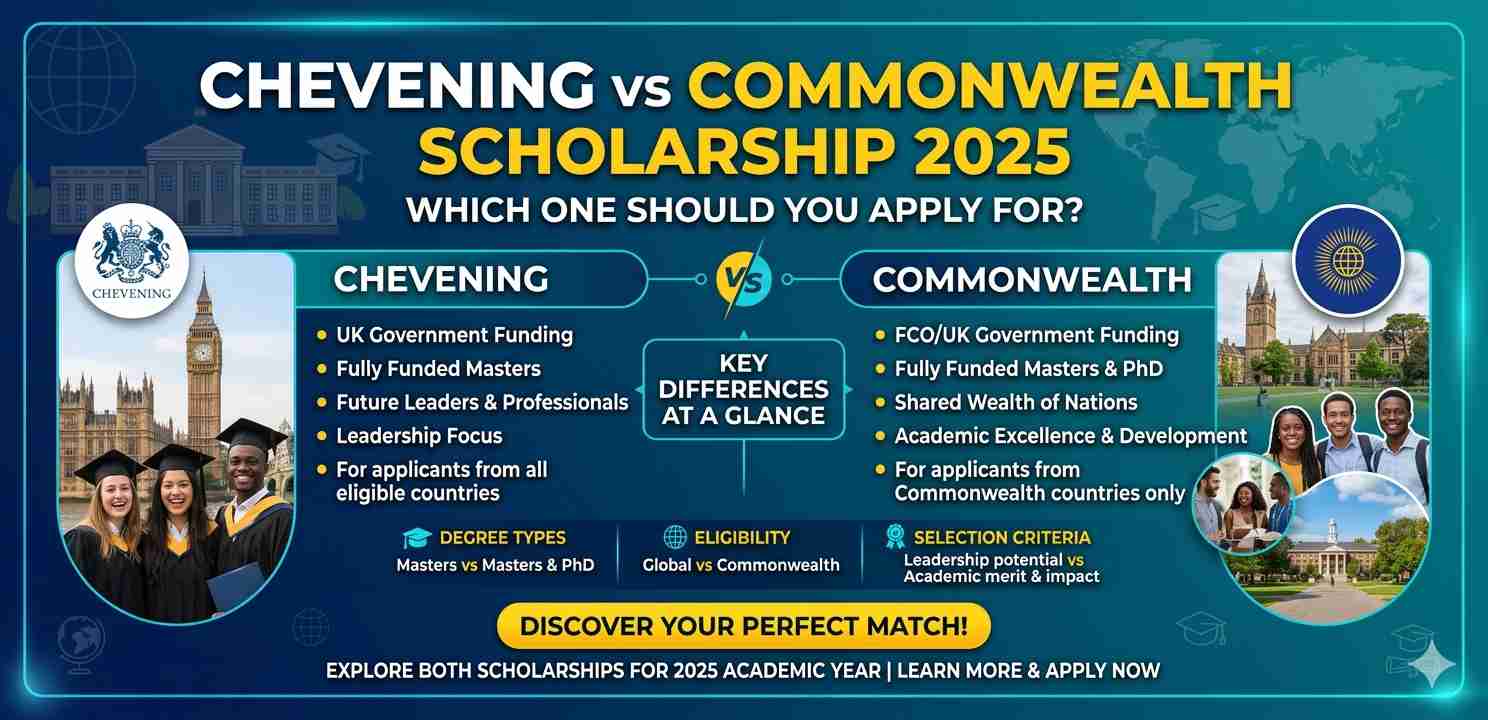
Introduction
Every year, thousands of students from developing countries sit with one big question in their heads — should I go for the Chevening vs Commonwealth scholarship? Both are prestigious UK-funded awards. Both are fully funded. And both are genuinely life-changing. But they are not the same, not even close.
If you are from South Asia, Africa, or any developing nation, chances are you have come across both these names more than once. The confusion is real. I have spoken to applicants who applied to both without really understanding what made them different — and some of them got rejected from both simply because their profile did not match what either programme was actually looking for.
This guide will break it all down. Simply. Honestly. No jargon.
What Is the Chevening Scholarship?
The Chevening scholarship is funded by the UK Foreign, Commonwealth and Development Office (FCDO). It was launched in 1983 and has since supported over 50,000 scholars from around 160 countries.
The whole idea behind Chevening is leadership. They are not just looking for academic toppers. They want people who will go back to their home countries and influence things — policy, business, civil society, media, or whatever their field happens to be.
When it comes to Chevening vs Commonwealth scholarship, the Chevening side is distinctly personality and network focused. The scholarship covers tuition, living expenses, flights, and even a thesis grant in some cases.
Who Is Chevening For?
- Working professionals with at least two years of full-time work experience
- People who can clearly show leadership potential through past roles
- Applicants who want to study in the UK for a one-year master’s programme
- Those who plan to return to their home country after completing the degree
One important thing — Chevening scholars must return to their home country for at least two years after completing their studies. This is a binding condition.
What Is the Commonwealth Scholarship?
The Commonwealth scholarship is managed by the Commonwealth Scholarship Commission (CSC) in the UK. It targets citizens of Commonwealth member countries and focuses more directly on academic excellence and development impact.
Unlike Chevening, the Commonwealth scholarship has multiple award types. You can apply for a master’s, a PhD, or even a split-site PhD. That flexibility is one of the key differences when comparing Chevening vs Commonwealth scholarship options.
The Commonwealth scholarship is also more development-oriented. They specifically look at how your proposed study will contribute to the sustainable development of your home country. It is less about you personally and more about what your education will do for people back home.
Who Is the Commonwealth Scholarship For?
- Citizens of Commonwealth countries (check the list — not all are eligible every year)
- Applicants who want to pursue a master’s or PhD in the UK
- Those with a strong academic background and a clear development angle
- People who may or may not have extensive professional experience
PhD applicants especially find Commonwealth a better fit because Chevening does not fund doctoral programmes at all.
Chevening vs Commonwealth Scholarship: Key Differences
Let’s lay out the most important differences clearly, because this is where most people get confused.
1. Programme Level
Chevening funds only one-year master’s degrees. Commonwealth funds master’s, PhD, and split-site PhD programmes.
This is often the first deciding factor. If you are planning to do a PhD, the choice is simple — Commonwealth is your path.
2. Focus: Leadership vs Development
When comparing Chevening vs Commonwealth scholarship, the philosophical difference matters a lot.
Chevening wants future leaders. Your application must demonstrate that you have shown leadership, that others look to you, and that you have a network you are building.
Commonwealth wants development champions. Your academic proposal must show how your study links to development challenges in your home country — education, health, agriculture, governance, technology, etc.
3. Work Experience Requirements
Chevening requires at least two years of work experience. This is non-negotiable. Fresh graduates almost never get the Chevening award.
Commonwealth, on the other hand, is more flexible. For master’s applicants, some work experience helps but is not mandatory. For PhD applicants, academic research experience matters more than professional employment.
4. Application Process
Both scholarships require multiple essays and references. But the structure is different.
For Chevening vs Commonwealth scholarship applications, Chevening asks four specific essays — leadership, networking, studying in the UK, and career plan. These are each 500 words and have to be very precise.
Commonwealth requires a study proposal that explains what you want to research and why it matters for development. The academic focus is heavier here.
5. Selection and Nationality
Chevening is open to over 160 countries. Commonwealth is open to Commonwealth member states — which is around 56 countries.
If your country is not a Commonwealth member, the decision is already made for you.
Can You Apply to Both at the Same Time?
Yes, technically you can. There is no rule against applying to Chevening vs Commonwealth scholarship in the same cycle. Many applicants do this to increase their chances.
However, you cannot hold both awards simultaneously. If you get shortlisted or selected for one, you will usually need to withdraw from the other.
Some applicants have been successful with both offers in the same year and had to make the tough choice. It is a good problem to have, honestly.
Which One Has a Better Success Rate?
Honestly, both are highly competitive. Chevening receives tens of thousands of applications each year and only awards about 1,500 to 1,800 scholarships globally. The Commonwealth scholarship numbers are smaller in terms of total awards but vary significantly by country.
In the Chevening vs Commonwealth scholarship debate, neither is “easier” to get. What matters more is how well your profile fits the specific criteria of each one.
A working professional with leadership experience, a strong network, and a clear career vision — Chevening. A researcher, academic, or someone with a strong development angle and postgraduate ambitions — Commonwealth.
Common Mistakes Applicants Make
This is something I find people almost never talk about openly. Here are real mistakes that cause rejections.
For Chevening:
- Writing vague leadership essays without real examples
- Applying without two years of work experience
- Choosing more than three universities without proper research into each
- Underestimating the importance of the networking essay
For Commonwealth:
- Submitting a weak or generic study proposal
- Not clearly linking the proposed study to national development
- Applying without a good academic track record
- Ignoring the importance of references from academic supervisors
In the Chevening vs Commonwealth scholarship space, the quality of your essays and proposals is everything. Both award bodies are experienced enough to spot a template response immediately.
Tips for a Strong Application in 2025
Whether you are applying for Chevening vs Commonwealth scholarship, some things remain constant.
Start early. Both scholarships open in mid-year (usually August–November for Chevening, and around the same period for Commonwealth). Do not wait until the last month.
Be specific. Vague ambitions do not win scholarships. Say exactly what you want to study, where, and why.
Get strong references. A letter from someone who genuinely knows your work or research is far more valuable than a generic note from a big name.
Tailor each application. Do not recycle essays between the two. Chevening vs Commonwealth scholarship applications require completely different tones and angles.
Research your universities. Both scholarships usually require you to name specific institutions. Know those departments, know the faculty, and ideally, make contact before applying.
Final Conclusion
So, Chevening vs Commonwealth scholarship — which one should you go for in 2025?
If you are a working professional with two or more years of experience, genuine leadership stories to share, and a master’s degree goal — Chevening fits your profile better.
If you are academically inclined, aiming for a PhD, or want to pursue development-focused research — Commonwealth is more aligned with your path.
And if both seem to match? Apply to both. Just make sure each application is written specifically for that award, not a copy-paste job.
Both scholarships can genuinely transform your career and give you access to one of the best education systems in the world. The difference is in what each one values — and knowing that difference is half the battle.