 admin@graminguru.in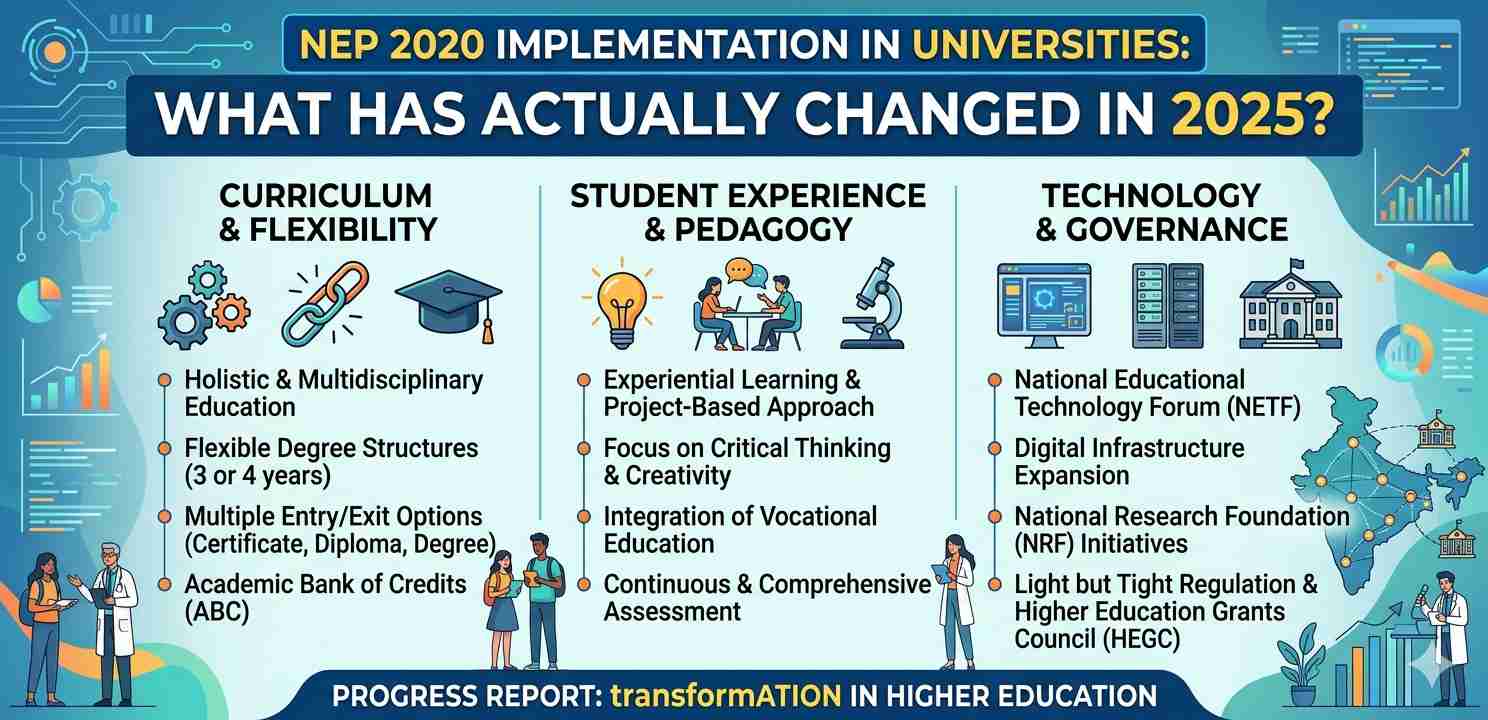
Introduction
When the National Education Policy 2020 was announced, it felt like a big promise. A complete overhaul of how Indian higher education works — flexible degrees, skill-based learning, multiple entry and exit options. Sounds great on paper. But the real question most students and teachers were asking was simple: will it actually happen?
Now that we’re in 2025, we finally have some answers. The NEP 2020 implementation in universities has moved from policy documents to real classrooms. Some changes are genuinely happening. Others are still slow. And a few are creating confusion on the ground. This article walks you through what has actually shifted, what remains incomplete, and what it means for you as a student or educator.
What NEP 2020 Was Actually Trying to Do
Before getting into what has changed, it helps to understand the original intent. The NEP 2020 implementation in universities was designed around one core idea: education should be flexible and relevant to real life.
The old system was rigid. You picked a subject, you studied it for three or four years, and that was that. No changing your mind. No mixing disciplines. If you dropped out midway, you left with nothing.
NEP 2020 wanted to change this completely. The four-year undergraduate program, the Academic Bank of Credits (ABC), multiple entry and exit options, multidisciplinary learning — all of these were part of the new vision.
The Four-Year Undergraduate Programme: Where Things Stand
One of the biggest structural changes under NEP 2020 implementation in universities is the shift to a four-year undergraduate programme (FYUP). By 2025, most central universities have adopted this format, and many state universities are in the process.
Here’s what it looks like in practice:
- Year 1 exit: Certificate
- Year 2 exit: Diploma
- Year 3 exit: Bachelor’s degree (pass)
- Year 4 exit: Bachelor’s degree with Honours or Research
This is a real change. A student who completes two years and needs to stop for financial or personal reasons can now walk away with a diploma — something they couldn’t do before. That matters a lot for first-generation college students.
However, implementation is uneven. Some colleges haven’t fully updated their curriculum. Faculty in several institutions are still teaching the same content, just stretched over four years. The structure exists, but the substance is still catching up.
Academic Bank of Credits: The Idea vs. The Reality
The Academic Bank of Credits (ABC) is a digital system where students can store credits they earn — even from different institutions. It’s one of the most innovative parts of NEP 2020 implementation in universities.
By 2025, the ABC portal is live and functional. Students can register, link their institution, and accumulate credits. Several universities, including Delhi University and Jawaharlal Nehru University, are actively using it.
But there are real problems. Many smaller colleges and state universities are barely aware of how to integrate with the system. Faculty are unsure how to award credits for non-traditional learning — like an online course or an internship. And students often don’t know this system even exists.
It’s a good idea. The execution needs more time and more support at the ground level.
Multiple Entry and Exit: Is It Working?
Yes — partially. The multiple entry and exit system is perhaps the most student-friendly part of NEP 2020 implementation in universities. It means students are not forced to lose everything if they leave early.
In cities like Hyderabad, Pune, and Bengaluru, students at well-resourced universities have started using this option. A student from a private university in Pune told me she paused her studies after year two to work, and the exit diploma she received helped her get a job with a slightly better pay grade than before.
But in rural colleges and tier-3 cities, the picture is very different. Admission processes, recognition of exit credentials, and re-entry pathways are still not clearly defined. A diploma from one university isn’t always recognized by employers who aren’t familiar with the new system.
The policy is there. The infrastructure to support it — counselling, employer awareness, clear re-entry rules — is still being built. Learn more about how ABC and multiple exit systems are designed to work from the University Grants Commission’s official guidance.
Multidisciplinary Courses: More Options, More Confusion
Another visible change in NEP 2020 implementation in universities is the push toward multidisciplinary education. A science student can now take a course in history or music. An economics student can study environmental science.
This sounds exciting, and for many students it is. Delhi University’s new curriculum introduced “Value Added Courses” and “Skill Enhancement Courses” that students can pick from other departments. Some students love it. They’re finally studying things they’re curious about.
But there’s a flip side. Many departments are under-staffed. When a hundred extra students suddenly sign up for a philosophy elective, the single available professor can’t handle the load. Timetable clashes are another common complaint. The flexibility is real, but the logistics are still catching up.
Skill-Based and Vocational Courses: A Genuine Shift
This is one area where NEP 2020 implementation in universities has made a noticeable difference. Universities are now required to include vocational or skill-based components in their curriculum.
Courses in coding, digital marketing, financial literacy, communication, and even farming technology are showing up in degree programmes across India. Some universities have partnered with industry for this — tying up with companies to design short courses that are actually relevant.
The quality varies a lot. A well-designed coding module at a tech-forward university in Chennai is very different from a “computer basics” course slapped onto a syllabus at a rural college. But the intent to connect education with employability is showing results in places where it’s done seriously.
Research Focus at the Undergraduate Level
One of the aspirational parts of NEP 2020 implementation in universities was making research a part of undergraduate education — not just postgraduate. The Honours with Research option in year four is the main vehicle for this.
In 2025, a few central universities and IITs have started offering structured undergraduate research opportunities. Students can work with faculty on projects, publish in journals, and get credit for it.
For most universities though, this is still theoretical. Research culture takes years to build. Faculty need to be incentivized, labs need funding, and students need mentors who have time for them. It’s moving, but slowly.
You can track the progress of NEP 2020-related reforms across Indian institutions through the National Education Policy implementation dashboard maintained by the Ministry of Education.
Languages and Medium of Instruction
NEP 2020 encouraged teaching in regional languages and mother tongue, especially at lower levels. At the university level, this is one of the more sensitive and complex changes.
Some universities in Tamil Nadu, Karnataka, and Maharashtra have started offering degree programmes in regional languages alongside English. This is a genuine step toward inclusion. A student from a small town who struggled with English can now access quality education in their own language.
But there are concerns too — about mobility, about the quality of translated study materials, and about whether regional-medium graduates will find equal opportunities in national job markets. These are real tensions that don’t have easy answers yet.
What Teachers Are Experiencing
No conversation about NEP 2020 implementation in universities is complete without listening to teachers. Most faculty members this writer spoke to had mixed feelings.
Many appreciated the intent — reducing rote learning, adding flexibility, encouraging inquiry. But they’re stretched thin. Redesigning an entire curriculum takes time and energy that already-overworked professors often don’t have. Training on the new frameworks has been inconsistent. In some places, faculty received one-day workshops. That’s simply not enough for a transformation of this scale.
Also worth noting: contract and ad-hoc faculty, who make up a huge portion of university teaching staff in India, are largely left out of the conversation about implementation. They carry much of the teaching load but have little say in how things change.
The Digital Infrastructure Question
NEP 2020 assumed a certain level of digital readiness — for online courses, ABC registration, digital credentialing, and blended learning models. In metros, this assumption holds reasonably well.
In many parts of India, it doesn’t. Patchy internet, limited devices, and low digital literacy among both students and teachers are real barriers. NEP 2020 implementation in universities cannot fully succeed without addressing this infrastructure gap.
Some progress is visible — SWAYAM courses, NPTEL integrations, and digital libraries have expanded. But they remain add-ons rather than core infrastructure in many institutions.
What Students Actually Think
Students are the ones experiencing all of this most directly. The response is genuinely mixed.
Many students appreciate the flexibility. Being able to choose electives, exit without losing everything, and explore different subjects feels liberating. First-year students who’ve grown up under the pressure of narrow academic tracks often find the new system a relief.
Others are frustrated by the confusion. Which courses count? How do you re-enter if you’ve exited? Will an employer understand this new format? These questions don’t always have clear answers — and that uncertainty causes real anxiety.
The NEP 2020 implementation in universities is changing things, but it also needs better communication with the people it’s meant to serve.
Final Conclusion
The NEP 2020 implementation in universities has made genuine, if uneven, progress by 2025. The structural pieces — four-year programmes, multiple entry-exit, credit banks, skill courses — are being put in place. In better-resourced universities, students are starting to feel the difference.
But the ground reality in smaller colleges, rural institutions, and understaffed departments tells a more complicated story. Implementation without adequate training, infrastructure, and awareness can turn good policy into confusing paperwork.
The direction is right. The pace needs to catch up — and more importantly, the people doing the actual work in classrooms need more support to make it real. For students navigating this shift, staying informed and asking questions is the best thing you can do.