 admin@graminguru.in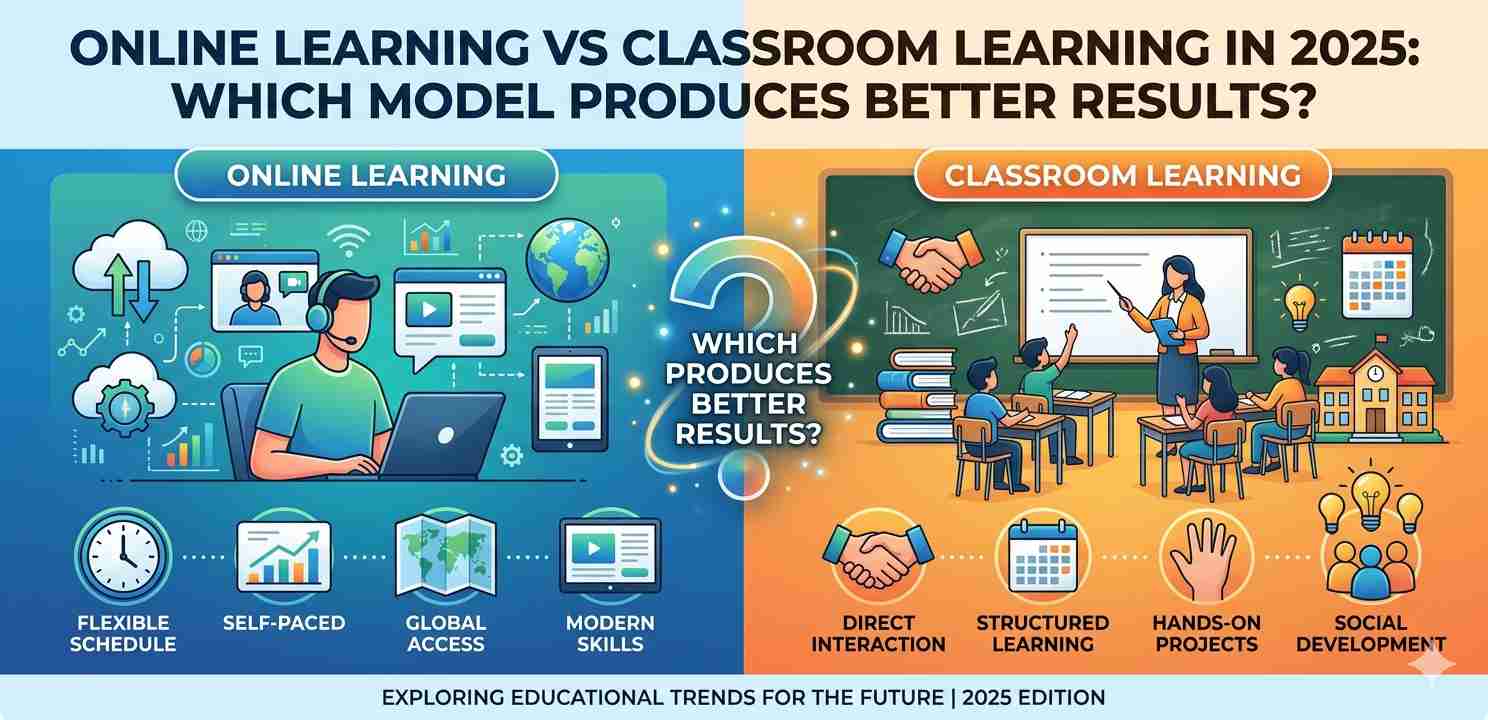
Introduction
Education has changed a lot over the last few years. And in 2025, the debate around online learning vs classroom learning is louder than ever. Parents are asking. Students are confused. Even teachers aren’t sure which model is actually delivering better results.
Whether you’re a school student trying to focus better at home, or a working adult looking to pick up a new skill — the platform you choose to learn on really does matter. This article breaks down both sides in a simple, honest way so you can figure out what actually works for you.
What Is Online Learning and How Does It Work in 2025?
Online learning means studying through a screen — using apps, video lectures, live classes, or recorded courses. Platforms like Coursera, Khan Academy, or even YouTube have made it possible for millions of people to learn almost anything from anywhere.
In 2025, online learning has grown more structured than it used to be. Many institutions now offer full degrees, certifications, and professional courses completely online. The tech has also improved — things like AI-based personalization, virtual classrooms, and real-time progress tracking have changed the experience significantly.
Still, not all online learning is the same. A student watching random videos is very different from someone enrolled in a properly structured online degree program.
What Is Classroom Learning and Why Does It Still Matter?
Classroom learning is the traditional model — students sitting in a physical space, interacting with a teacher, asking questions face to face, and working alongside peers.
It’s been around for centuries, and there’s a reason it hasn’t gone away. The structure, the social environment, and the immediate feedback loop that comes from a physical classroom are genuinely hard to replace.
In 2025, many schools and colleges have updated their classroom experiences too. Smartboards, tablets, and hybrid models have made traditional classrooms more tech-integrated than before. So this isn’t just chalk-and-blackboard anymore.
Online Learning vs Classroom Learning: Flexibility and Access
One of the biggest advantages in the online learning vs classroom learning debate is flexibility. With online learning, you set your own schedule. If you’re someone who works a job, takes care of family, or lives in a remote area — this is huge.
A student in a small town in India, for example, can access a world-class lecture from MIT without leaving home. That kind of access simply wasn’t possible even ten years ago.
Classroom learning, on the other hand, requires you to be physically present at a fixed time. That’s a genuine constraint. But it also forces a kind of discipline that many students actually need.
Who Benefits More from Flexibility?
Adult learners and working professionals clearly benefit more from online learning’s flexible scheduling. But younger students — especially those in school — often do better with the structured timetable that a classroom provides.
Learning Outcomes: Does Online or Classroom Produce Better Results?
This is the heart of the online learning vs classroom learning question. And honestly, the answer isn’t simple.
Research from 2023 and 2024 showed that students in structured online programs performed at a similar level to classroom students — sometimes even slightly better — when it came to knowledge retention in subjects like math, coding, and language learning.
But here’s the catch. That result held true only when the student was motivated, self-disciplined, and had access to proper internet and devices. When those conditions weren’t met, classroom students almost always outperformed.
This means outcomes depend heavily on the learner, not just the platform.
Social Skills and Peer Interaction
One thing classroom learning does really well is build soft skills. Group projects, debates, classroom discussions, and just being around other students — all of this builds communication, teamwork, and social confidence in a way that’s difficult to replicate online.
In the online learning vs classroom learning comparison, this is a clear win for traditional classrooms. Many students who studied fully online during the pandemic years reported feeling isolated and less confident in social settings afterward.
That’s not a small thing. Social skills matter in the real world, and a learning model that ignores them is missing something important.
Teacher Interaction and Real-Time Feedback
In a classroom, you can raise your hand, ask a question, and get an answer immediately. The teacher can also read the room — notice if students look confused, slow down, or adjust the lesson on the fly.
Online learning has improved a lot here. Live video classes do allow some real-time interaction, but it’s still not the same. There’s usually a slight delay, fewer students feel comfortable unmuting, and teachers can’t see body language as clearly.
For subjects that require hands-on explanation — like science experiments, art, or physical education — classroom learning is still far ahead.
Cost Comparison: Which Is More Affordable?
When comparing online learning vs classroom learning on cost, online usually comes out cheaper. There are no commuting costs, no physical infrastructure to maintain, and many quality resources are either free or low-cost.
For someone learning a skill like graphic design, coding, or digital marketing — free YouTube tutorials combined with an affordable Coursera course can genuinely replace what used to cost thousands in tuition fees.
That said, premium online programs at recognized universities can be expensive too. And classroom learning for government-funded schools in countries like India is often free or nearly free. So cost comparison really depends on the specific institution and country.
Online Learning vs Classroom Learning for Different Age Groups
Age matters a lot here. Let’s be honest — a 7-year-old learning through a screen for six hours a day is not ideal. Young children need physical activity, face-to-face interaction, and hands-on exploration that a classroom provides naturally.
Teenagers and older students can manage online learning better, especially if they’re self-motivated. And for adults — especially working professionals — online learning is often the only realistic option.
Which Model Works Best for Professional Certifications?
For professional certifications and upskilling, online learning vs classroom learning almost always tilts toward online. The flexibility, access to international instructors, and self-paced nature make it practical for people balancing work and study.
The Role of Discipline and Self-Motivation
This is probably the biggest factor that doesn’t get enough attention. Online learning puts a lot of responsibility on the learner. There’s no teacher watching you, no peer pressure to show up, and no bell telling you class starts.
If you’re the kind of person who struggles with procrastination — and honestly, most people do at some level — purely online learning can be genuinely difficult. Many online courses report very high dropout rates, sometimes above 80%.
Classroom learning builds routine. You show up, sit down, and learn — even on days when you don’t feel like it. That structure has real value.
Hybrid Learning: A Middle Ground That’s Gaining Ground
In 2025, many institutions are moving toward a hybrid model — combining the best of both approaches. Students might attend in-person classes a few days a week and complete coursework online the rest of the time.
This approach is showing promising results. It addresses the flexibility problem while keeping the social and structured elements of classroom learning intact. Many universities, corporate training programs, and even high schools are experimenting with this model.
The hybrid model may well be the answer to the online learning vs classroom learning debate — not choosing one, but blending both intelligently.
Technology Access and the Digital Divide
One uncomfortable truth about online learning is that it assumes everyone has a decent internet connection, a working device, and a quiet space to study. That’s not reality for a large part of the world.
In countries like India, many students in rural areas still lack reliable internet. For them, classroom learning isn’t just a preference — it’s the only genuinely accessible option.
Any honest discussion of online learning vs classroom learning has to acknowledge this divide. Promoting online-only models without addressing access issues can actually increase educational inequality rather than reduce it.
Which Model Is Better for Skill-Based Learning?
For practical, skill-based learning — things like photography, music, cooking, or woodworking — classroom or in-person instruction generally wins. You need someone to watch you do it and correct your technique in real time.
But for knowledge-based skills — writing, programming, data analysis, languages — online learning can be just as effective, and sometimes more so, because you can rewatch, pause, and practice at your own pace.
This distinction is worth keeping in mind when you’re deciding which model suits your specific learning goal.
External Resources Worth Exploring
If you’re evaluating online programs, the QS World University Rankings can help you identify institutions that offer credible online degrees with global recognition.
For research-backed insights on learning outcomes across both models, the U.S. Department of Education’s meta-analysis on online learning is a thorough resource that’s worth reading before making a major decision.
Final Conclusion
The debate around online learning vs classroom learning doesn’t have a single correct answer — and that’s actually okay. Both models have genuine strengths and real limitations.
Online learning offers flexibility, access, and often lower costs. Classroom learning provides structure, social development, and real-time support. What works best depends on your age, your subject, your learning style, your access to technology, and honestly, how disciplined you are.
In 2025, the smartest approach is to stop thinking of these as opposites. Use online resources to supplement what you’re learning in a classroom. Or use the structure of a hybrid program to stay accountable while keeping the flexibility you need.